

Published: August 8, 2026 | Last updated: August 8, 2026 | 16 min read
TL;DR
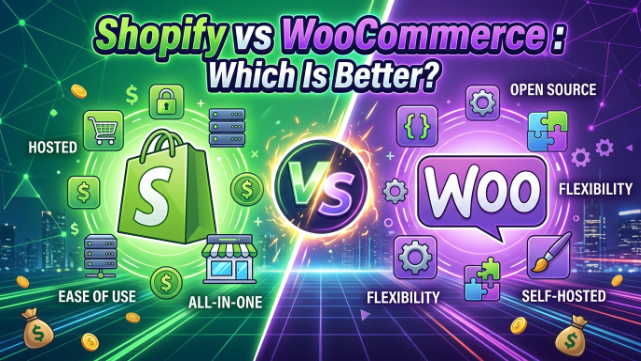
- Shopify and WooCommerce power more online stores between them than every other ecommerce platform combined. The Shopify vs WooCommerce decision almost always comes down to one question: do you want to own your store, or rent it? (Cartflows, 2026)
- Shopify wins for most merchants in 2026 – faster setup (hours vs days), managed hosting, 24/7 support, and lower technical overhead. WooCommerce wins for technical users who need full control, unlimited customization, and lower long-term costs. (ToolRadar, 2026; Victoria Garland, 2026)
- Shopify’s Basic plan costs **$29/month** (annual) with 2.9% + $0.30 transaction fees. WooCommerce is free to install but requires hosting ($6–$350/month) and extensions ($29–$299/year each). (Dropbuild, 2026; WooCommerce, 2026)
- Shopify is faster by default – average site speed of 1.2 seconds vs WooCommerce’s hosting-dependent 2.17+ seconds. Shopify renders 2.4x faster on average than competitors. (Shopify, 2026)
- Bottom line: Shopify is better for beginners, dropshippers, and non-technical founders. WooCommerce is better for developers, content-heavy brands, and businesses that need full ownership and customization. Neither is universally better – the choice depends on your technical comfort and business goals. (ToolRadar, 2026)
Shopify vs WooCommerce at a Glance
| Feature | Shopify | WooCommerce |
|---|---|---|
| Type | Hosted platform (you rent it) | WordPress plugin (you own it) (Cartflows, 2026) |
| Starting cost | $29/month (annual, Basic) (Dropbuild, 2026) | Free plugin + hosting ($6–$350/month) (WooCommerce, 2026) |
| Transaction fees | 2.5–2.9% + $0.30 (Shopify Payments) | Only what your payment gateway charges (Cartflows, 2026) |
| Setup time | 1–3 hours (Hosting.com, 2026) | 1–2 days (technical) (Metorik, 2026) |
| Hosting | Fully managed by Shopify (Omnisend, 2026) | Your responsibility (Cartflows, 2026) |
| Customization | Limited (theme-based) (Metorik, 2026) | Unlimited (open-source) (Metorik, 2026) |
| Apps/Plugins | ~8,000 curated apps (Metorik, 2026) | ~70,000+ plugins (Metorik, 2026) |
| SEO | Good out-of-the-box (Skalum, 2026) | Excellent (full WordPress control) (Finder, 2026) |
| Mobile speed | 2.8s mobile LCP (PageSpeedMatters, 2026) | 3.6s mobile LCP (hosting-dependent) (PageSpeedMatters, 2026) |
| Checkout conversion | 68.4% completion rate (Baymard, 2025) | 61.2% completion rate (Baymard, 2025) |
| 87% satisfaction vs 68% for WooCommerce (EasyAppsEcom, 2026) |
What Is the Core Difference Between Shopify and WooCommerce?
The core difference between Shopify and WooCommerce is who owns and runs the store’s infrastructure. (Cartflows, 2026)
WooCommerce is a free WordPress plugin you install on hosting you choose. You own your code, your data, and your store outright. You handle hosting, security, and updates yourself. (Cartflows, 2026) As of May 2026, Store Leads tracks 4.34 million live WooCommerce stores against 2.84 million live Shopify stores. WooCommerce still leads by raw store count. (Cartflows, 2026)
Shopify is a fully hosted subscription platform. It manages hosting, security, and updates for you, and you pay a recurring bill that grows as your store does. Shopify pulls ahead among the highest-traffic, highest-revenue brands. (Cartflows, 2026)
Think of it this way: Shopify is a car you drive off the lot and maintain with regular oil changes. WooCommerce is a car you also have to assemble, tune, and sometimes fix on the side of the road. Both can get you where you’re going. The question is how much of your time you want to spend on the vehicle versus the destination. (Ecommerce Paradise, 2026)
Shopify vs WooCommerce Pricing 2026
Shopify Pricing (2026)
Shopify reshuffled and renamed its plans in late 2025. The middle plan, previously called “Shopify,” is now called “Grow.” (Dropbuild, 2026)
| Plan | Monthly | Annual (per mo) | Transaction Fee | Best For |
|---|---|---|---|---|
| Starter | $5/mo | $5/mo | N/A | Social sellers, links only (Dropbuild, 2026) |
| Basic | $39/mo | $29/mo | 2.9% + $0.30 | Solo entrepreneurs, full store (Dropbuild, 2026) |
| Grow | $105/mo | $79/mo | 2.7% + $0.30 | Small teams, 5 staff accounts (Dropbuild, 2026) |
| Advanced | $399/mo | $299/mo | 2.5% + $0.30 | Global reach, 15 staff accounts (Dropbuild, 2026) |
| Plus | from $2,300/mo | Custom | Custom | Complex businesses (Dropbuild, 2026) |
Key notes:
- Shopify currently runs a $1/month promo for the first 3 months on most plans. (Dropbuild, 2026)
- Using a third-party gateway (not Shopify Payments) adds an extra 0.6%–2% fee on every transaction. (Dropbuild, 2026)
- A rough rule: stay on Basic until you hit ~$25,000/month in revenue**, upgrade to Grow between **~$25,000 and ~$120,000/month**, and upgrade to Advanced above **~$120,000/month. (Dropbuild, 2026)
WooCommerce Pricing (2026)
WooCommerce is free to download and use, with no platform fees and no revenue share. You choose where to invest your budget. (WooCommerce, 2026)
| Cost Category | Typical Monthly Cost | Notes |
|---|---|---|
| Platform fee | $0 | Free, open-source (WooCommerce, 2026) |
| Hosting | $6–$350/mo | Shared $6–$50; managed $30–$150; scales with traffic (WooCommerce, 2026; Bluehost, 2026) |
| Domain | $1–$2/mo | $10–$20/year (Omnisend, 2026) |
| Extensions | $29–$299/year each | Add features à la carte (WooCommerce, 2026) |
| Payment processing | 2.9% + $0.30 (WooPayments) | No platform fee on top (WooCommerce, 2026) |
| SSL certificate | $0–$10/mo | Often included with hosting |
(WooCommerce, 2026; Omnisend, 2026)
WooCommerce’s annual TCO ranges from $500 to $3,000 for a functional store, versus Shopify’s $1,500 to $10,000+. (Inventory.io, 2026)
Pricing Verdict
WooCommerce is typically cheaper long-term and gives you full ownership of your store, but you handle hosting, updates, and security yourself. Shopify costs more as you scale – its subscription, transaction fees, and paid apps add up fast – but it launches in hours with no technical maintenance. (Cartflows, 2026)
Shopify typically costs $50–$75/month all-in, while WooCommerce can range from $20–$50/month – but hidden costs like premium plugins and developer time can make WooCommerce more expensive for non-technical users. (Metorik, 2026)
Shopify vs WooCommerce for Dropshipping
For most dropshippers, especially beginners, Shopify wins. (Ecommerce Paradise, 2026)
Why Shopify wins for dropshipping:
- Faster setup – 1.6 days average vs WooCommerce’s 4.2 days. (Gochyu, 2026)
- More reliable app ecosystem – Shopify has a wider and more reliable app ecosystem for dropshipping automation. WooCommerce plugins vary significantly in quality, update frequency, and compatibility. (Banzota, 2026)
- Survives traffic spikes – Shopify handles Black Friday traffic without crashing. WooCommerce performance depends entirely on your hosting. (Gochyu, 2026)
- Clean payment processing – Shopify processes payments more cleanly out of the box. (Gochyu, 2026)
When WooCommerce wins for dropshipping:
- WooCommerce is cheaper to run at scale. (Gochyu, 2026)
- Shopify wins below 500 orders per month. WooCommerce wins above 500 once you factor in transaction fees. (Gochyu, 2026)
- WooCommerce is better suited to merchants who already have WordPress expertise or dependable technical support. (Buckydrop, 2026)
Shopify vs WooCommerce SEO 2026
The honest verdict: neither platform ranks for you – Google ranks pages, not platforms. (Skalum, 2026)
Shopify SEO pros:
- Shopify gets most stores to solid SEO faster because HTTPS, canonical tags, sitemaps, hosting speed, and now AI discoverability are handled for you. (Skalum, 2026)
- Built-in schema, mobile-ready themes, and native JSON-LD for Product, Review, FAQ, and Breadcrumb. (Skalum, 2026)
- Native Agentic Storefronts via Shopify Catalog – visible in AI shopping channels (ChatGPT, Microsoft Copilot, Perplexity) out of the box. (Skalum, 2026)
- Shopify is the lower-risk SEO choice for most commercial stores without a dedicated developer. (Skalum, 2026)
WooCommerce SEO pros:
- WooCommerce on WordPress gives you maximum content and URL control – full permalink and category control, complete WordPress CMS depth, and deeper plugin options. (1DigitalAgency, 2026; Skalum, 2026)
- WooCommerce is stronger for content-led, topical-authority SEO because WordPress is a better content and blogging engine. (MediaPlus, 2026)
- WooCommerce gives you full control over custom URL hierarchies, full schema editing, and editorially distinct international sites – but only if you have the developer time to actually use that freedom. (Skalum, 2026)
The practical difference: Industry analysis in 2026 found WooCommerce stores tend to rank for more organic keywords on average in the same niche, largely because WordPress is a stronger content and blogging engine. (MediaPlus, 2026) However, Shopify’s speed, security, and maintenance advantages often outweigh WordPress’s SEO edge for most ecommerce stores. (Shopify Agency Directory, 2026)
Is Shopify Faster Than WooCommerce?
Yes – Shopify is faster by default. (PageSpeedMatters, 2026)
| Metric | Shopify | WooCommerce |
|---|---|---|
| Average site speed | 1.2 seconds | 2.17+ seconds (hosting-dependent) (Shopify, 2026) |
| Mobile LCP | 2.8s | 3.6s (PageSpeedMatters, 2026) |
| Core Web Vitals pass rate | 52% | 38% (PageSpeedMatters, 2026) |
| Time to First Byte (TTFB) | 320ms | 580ms (PageSpeedMatters, 2026) |
| Rendering speed | 2.4x faster than competitors | Hosting-dependent (Shopify, 2026) |
Shopify’s CDN and global delivery are fast out of the box. Your WooCommerce website speed depends entirely on your server speed. Shared hosting is slower than any Shopify solution. (Sherocommerce, 2026)
Shopify vs WooCommerce Reddit 2026: What Users Say
Based on 69 Reddit mentions across 10 subreddits, WooCommerce has a 45% positive sentiment score in the Ecommerce Platforms space. (Reddgrow, 2026)
What Reddit users say about Shopify:
- Support ignores you when it matters – one dev ranted that the app review team ignores emails and basic instructions. Tier-1 support reads from scripts. (GrowwwTech, 2026)
- Payments can freeze your cash flow – a merchant reported Shopify withheld over $37,000 from their business during a payment-processor dispute. (GrowwwTech, 2026)
- Free features quietly turn paid – merchants got 10 days to opt out of a paid Shopify Tax tier. You don’t control the roadmap. (GrowwwTech, 2026)
- Vendor lock-in is real – your data lives in Shopify’s schema. Migrating out means rebuilding URLs, redirects, customer accounts, reviews, and subscription logic. Founders call it a “one-way door.” (GrowwwTech, 2026)
What Reddit users say about WooCommerce:
- Every store seems to run slow – one developer asked why every WooCommerce store runs on a potato. Bloated code, too many plugins, sluggish admin – it’s the platform’s default state without serious tuning. (GrowwwTech, 2026)
- Bloat and bad UI are baked in – WooCommerce’s admin interface has not improved meaningfully in years. (GrowwwTech, 2026)
- Reddit users consistently praise WooCommerce for having zero built-in transaction fees and full data ownership. The common complaint is that a “free” WooCommerce store rarely stays free once you add hosting, SSL, premium extensions, and a page builder. (Mediafa.st, 2026)
BigCommerce vs Shopify
BigCommerce is Shopify’s closest hosted competitor. Here’s how they compare: (Ecommerce Fastlane, 2026)
| Feature | Shopify | BigCommerce |
|---|---|---|
| Starting price | $29/mo (annual) | $19–$29/mo (Ecommerce Fastlane, 2026) |
| Transaction fees | 2.5–2.9% + $0.30 | 0% (no transaction fees) (Ecommerce Fastlane, 2026) |
| Ecosystem size | Largest (8,000 apps) | Smaller (IWD Agency, 2026) |
| Time to launch | Faster | Slightly slower (IWD Agency, 2026) |
| B2B features | Basic (Plus) | Stronger native B2B (IWD Agency, 2026) |
BigCommerce provides predictable costs with no transaction fees, while Shopify is initially cheaper but may incur extra fees for sellers not using Shopify Payments. (Ecommerce Fastlane, 2026)
WooCommerce vs Magento
Magento (now Adobe Commerce) is the enterprise alternative. (WeltPixel, 2026)
| Feature | WooCommerce | Magento |
|---|---|---|
| Best for | Small-to-medium stores, content-driven stores, WordPress users (Jotform, 2025) | Large catalogs, complex customization, multi-store setups, enterprise B2B (WeltPixel, 2026) |
| Setup difficulty | Easier, faster to set up (Jotform, 2025) | More complex, requires development team (WeltPixel, 2026) |
| Cost | Lower entry cost | Higher (enterprise pricing) (WeltPixel, 2026) |
| Scalability | Can struggle with performance at scale (WeltPixel, 2026) | Better scalability, enterprise-grade (WeltPixel, 2026) |
Shopify vs WordPress (Without WooCommerce)
WordPress without WooCommerce is just a content management system – it doesn’t have native ecommerce features. (Cybernews, 2026)
| Feature | Shopify | WordPress (without WooCommerce) |
|---|---|---|
| Ecommerce features | Built-in | Requires plugins (Cybernews, 2026) |
| Design flexibility | Limited to templates | High (thousands of themes) (Cybernews, 2026) |
| Cost estimate | $29–$299/month | $5–$50/month + plugins (Cybernews, 2026) |
| Ease of use | Winner – Shopify outperforms WordPress in ease of use (Cybernews, 2026) | Moderate |
Shopify vs WooCommerce for Small Businesses
Shopify is the best ecommerce platform for small businesses in 2026. (G2, 2026)
Why Shopify wins for small businesses:
- Easy-to-manage platform with strong scalability and a large app ecosystem. (G2, 2026)
- Faster to launch – store live in 2-3 days vs WooCommerce’s 2-3 weeks minimum. (LinkedIn, 2026)
- No technical management – Shopify handles hosting, security, and updates. (DreamHost, 2026)
- Predictable monthly costs – Shopify’s $29/month is often lower than a properly maintained WooCommerce store. (Victoria Garland, 2026)
When WooCommerce wins for small businesses:
- You already use WordPress and have technical resources. (DreamHost, 2026)
- Cost control and content-driven growth matter most. (Cartflows, 2026)
- You need deep, unusual customization that Shopify doesn’t offer. (Victoria Garland, 2026)
Troubleshooting Table: Common Platform Issues and Solutions
| Problem | Platform | Cause | Fix |
|---|---|---|---|
| High monthly costs from apps | Shopify | App subscriptions add up | Audit your apps monthly; remove unused apps (Alidropship, 2026) |
| Third-party transaction fees | Shopify | Not using Shopify Payments | Switch to Shopify Payments to eliminate the extra 0.6%–2% fee (Dropbuild, 2026) |
| Store runs slow | WooCommerce | Bloated code, too many plugins | Tune your hosting; use caching; audit and remove unnecessary plugins (GrowwwTech, 2026) |
| Checkout not converting | WooCommerce | Missing optimization | Use CartFlows or similar tool to get Shopify-style checkout flows (Cartflows, 2026) |
| Site security vulnerabilities | WooCommerce | Self-hosted responsibility | Keep WordPress, WooCommerce, and all plugins updated; use security plugins (Cartflows, 2026) |
| Vendor lock-in concerns | Shopify | Data lives in Shopify’s schema | Use Shopify’s data export tools; plan migration carefully; consider starting with a custom domain you own (GrowwwTech, 2026) |
Frequently Asked Questions
Is Shopify better than WooCommerce?
For most merchants in 2026, yes – Shopify wins for the vast majority of businesses selling online. It’s faster to launch (hours vs days), easier to manage (no hosting/security headaches), and has better out-of-the-box performance. WooCommerce is the right choice for a specific type of operator – technical users who need full control and unlimited customization. (ToolRadar, 2026; HukCommerce, 2026)
Is Shopify better than WooCommerce for small businesses?
Yes. Shopify is the best ecommerce platform for small businesses in 2026. It’s easy to manage, scalable, and has a large app ecosystem. WooCommerce requires technical management that many small business owners don’t have the time or skills for. (G2, 2026; DreamHost, 2026)
Is WooCommerce better than Shopify on Reddit?
Reddit sentiment is mixed. Users praise WooCommerce for zero built-in transaction fees and full data ownership. The common complaint is that a “free” WooCommerce store rarely stays free once you add hosting, SSL, premium extensions, and a page builder. Shopify users complain about support, payment freezes, and vendor lock-in. (Mediafa.st, 2026; GrowwwTech, 2026)
Is Shopify faster than WooCommerce?
Yes – Shopify is faster by default. Shopify’s average site speed is 1.2 seconds versus WooCommerce’s 2.17+ seconds (hosting-dependent). Shopify renders 2.4x faster on average. Shopify’s CDN and global delivery are fast out of the box. WooCommerce speed depends entirely on your server speed. (Shopify, 2026; Sherocommerce, 2026)
Shopify vs WooCommerce pricing: Which is cheaper?
WooCommerce is typically cheaper long-term ($500–$3,000/year TCO) versus Shopify ($1,500–$10,000+/year TCO). But Shopify’s $29/month entry is often lower than a properly maintained WooCommerce store with hosting, security, and maintenance costs factored in. For non-technical users, WooCommerce’s hidden costs (developer time, premium plugins) can make it more expensive. (Cartflows, 2026; Inventory.io, 2026)
Shopify vs WooCommerce for dropshipping: Which is better?
Shopify wins for most dropshippers, especially beginners. Shopify gets you live faster (1.6 days vs 4.2 days), has a more reliable dropshipping app ecosystem, survives Black Friday traffic without crashing, and processes payments more cleanly. WooCommerce is cheaper at scale but requires more technical management. (Ecommerce Paradise, 2026; Gochyu, 2026)