

[Published: May 12, 2026 | Last updated: May 12, 2026] | 12 min read
TL;DR
- Automatic lead generation software finds, qualifies, and routes prospects without manual research – saving sales teams hours per day.
- The lead generation software market is worth $6.44 billion in 2026, growing at a 9.6% CAGR – which means the tooling landscape is moving fast and choosing the wrong platform is costly.
- Apollo.io is the strongest all-in-one pick for SMB and mid-market teams; ZoomInfo leads for enterprise with deep intent data.
- 80% of marketers say marketing automation software generates more leads and conversions, but only teams with clean ICP targeting and AI-assisted scoring are pulling ahead.
- 61% of B2B teams now use AI for lead scoring – up from 23% in 2024 – making AI-native platforms the new standard, not a premium add-on.
What Is Automatic Lead Generation Software?
Automatic lead generation software handles the process of finding, capturing, enriching, scoring, and routing potential customers – without a sales rep doing it manually. You set the criteria (job title, company size, industry, intent signals), and the software does the prospecting.
The category spans three distinct tool types. Outbound prospecting tools (Apollo.io, ZoomInfo, Cognism) pull contact data from large B2B databases and let you build targeted lists. Inbound capture tools (HubSpot, Unbounce, OptinMonster) convert website visitors into leads through forms, landing pages, and chat. AI enrichment and orchestration tools (Clay, 6sense) layer signals and scoring on top of raw contact data to prioritize who your team should contact first.
Most teams use a combination. A typical mid-market stack looks like: Apollo or ZoomInfo for prospecting, HubSpot or Salesforce as the CRM, and a sequencing tool like Outreach or Salesloft for execution.
Why Automatic Lead Generation Matters More in 2026
Manual prospecting at scale no longer works economically. The median B2B cost-per-lead reached $213 in early 2026, up from $198 in 2025 (HubSpot State of Marketing 2026). At that price, every unqualified lead your team chases is wasted budget.
The performance gap between teams using automation and those without is widening sharply. The top quartile of demand-gen teams now converts MQL to SQL at more than twice the median rate and pays roughly half the cost per lead for the same pipeline. The gap is driven by AI-assisted scoring, routing, and enrichment – not by spending more on ads.
61% of marketers say generating quality leads is their top challenge in 2026 (Martal). The problem is not finding contacts – it is finding the right contacts at the right moment. That is exactly what modern lead generation software is built to solve.
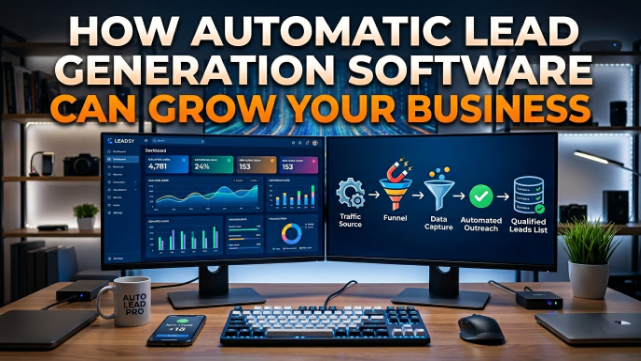
How Automatic Lead Generation Software Works
Understanding the core mechanics helps you evaluate tools against your actual workflow rather than feature marketing copy.
Step 1 – Contact Discovery: The software searches a B2B database or scrapes web signals to find people and companies matching your Ideal Customer Profile (ICP). You define filters: industry, company headcount, revenue range, job title, technology stack used, and geography.
Step 2 – Data Enrichment: Raw contact records get filled in with verified email addresses, phone numbers, firmographic data (company details), and technographic data (what software they use). This is where data accuracy becomes the critical differentiator between platforms.
Step 3 – Intent Scoring: AI-powered predictive analytics identify accounts showing buying signals – pulling from behavioral and demographic data to automate lead scoring and prioritization, reducing manual effort by up to 81% (360i Research). Intent signals flag which accounts are actively researching your category right now.
Step 4 – CRM Sync and Routing: Leads flow into your CRM (Salesforce, HubSpot, Pipedrive) with all enriched fields populated. Routing rules send each lead to the right rep or sequence based on territory, segment, or score.
Step 5 – Automated Outreach: Sequencing tools trigger personalized email, LinkedIn, and phone touchpoints based on lead behavior and score – with follow-ups running automatically until a response is logged.
7 Best Automatic Lead Generation Software Tools in 2026
The tools below cover the full range of team sizes and use cases – from solo founders to enterprise revenue teams.
1. Apollo.io – Best All-in-One for SMB and Mid-Market
Apollo combines a B2B contact database, email sequencing, a built-in phone dialer, and an AI agent layer in one platform. It is the clearest option for teams that want to prospect and engage leads without juggling multiple tools.
Apollo covers B2B contact data with email and phone numbers, built-in email sequencing, CRM sync with Salesforce and HubSpot, a Chrome extension for LinkedIn prospecting, and AI Sales Platform agents that prospect, draft, and follow up.
Pricing: Free tier available. Paid plans from $49/seat/month (Basic), $79/seat/month (Professional), $119/seat/month (Organization). G2 Rating: 4.7/5 based on 9,015+ reviews (G2, 2026) Best for: SMB teams, solo SDRs, startups that want one platform for data and outreach.
One real limitation: Apollo’s data accuracy sits around 75% for some contact types, so high-value enterprise outreach may need a verification step before dialing.
2. ZoomInfo – Best for Enterprise Intent Data
ZoomInfo is the largest B2B data platform in the category. It goes beyond contact records to deliver real-time buying intent signals, technographic data, and organizational hierarchy maps that enterprise sales teams need for account-based marketing.
ZoomInfo Copilot blends first-party CRM data with ZoomInfo’s intelligence to recommend who to reach, when to engage, and what to say – then helps execute across channels. It integrates natively with Salesforce, HubSpot, Microsoft Dynamics, and major sales engagement tools.
Pricing: Custom quote only. Typically $15,000-$40,000/year for small enterprise teams. Best for: Mid-market and enterprise teams running ABM programs with dedicated RevOps support.
ZoomInfo makes sense when intent data and data orchestration are core to your sales motion. It is not cost-effective for teams under 10 sales reps.
3. HubSpot Sales Hub – Best for Inbound-Led Teams
HubSpot is the right platform when your leads come inbound – through content, ads, or search – rather than cold outbound. It manages capture, scoring, nurturing, and CRM in one system.
HubSpot’s Breeze AI layer provides lead scoring, content generation, and workflow automation. Lead capture forms, landing pages, and email marketing tools support inbound lead generation. HubSpot’s CRM automatically tracks prospect interactions across email, website visits, and content downloads to build engagement timelines.
Pricing: Free CRM tier. Sales Hub Starter from $15/seat/month. Professional from $90/seat/month. Best for: SMB and mid-market teams with an inbound content motion. Outbound-heavy teams typically supplement HubSpot with Apollo or ZoomInfo for contact data.
4. Clay – Best for Custom Enrichment Workflows
Clay is a spreadsheet-style platform where each row is a prospect and AI agents automatically fill columns with enriched data. It is the tool of choice for RevOps and growth teams that want full control over their enrichment logic without writing code.
Clay supports integration with data providers including ZoomInfo, Clearbit, Apollo, and many others. Conditional logic and branching create sophisticated enrichment and routing workflows, making it well-suited to GTM operations teams that want to build custom enrichment pipelines without engineering resources.
Pricing: Free tier. Paid plans from $149/month. Best for: Growth-stage SaaS teams with a dedicated RevOps function and non-standard ICP definitions.
5. 6sense – Best for Predictive ABM
6sense identifies anonymous companies visiting your website and overlays intent signals to predict which accounts are in-market before they ever fill out a form.
6sense provides intent data and predictive analytics for account-based marketing programs. The platform uses AI to identify accounts showing buying signals across the web, analyzing anonymous website visits, content consumption, and research behavior to predict which companies are in-market for specific solutions.
Pricing: Custom. Entry-level packages typically start around $2,000/month. Best for: B2B companies with long sales cycles selling to named accounts.
6. Cognism – Best for GDPR-Compliant European Prospecting
Cognism focuses on compliant contact data for teams selling into European markets. Its Diamond Data product uses phone-verified contacts rather than algorithmically predicted numbers.
Cognism is a B2B data provider focused on GDPR-compliant contact intelligence and European market coverage, specializing in verified mobile numbers through its Diamond Data product, which uses phone-verified contacts to ensure accuracy.
Pricing: Custom quote. Contact Cognism directly for current pricing. Best for: Any team doing outbound into EU markets where GDPR compliance is non-negotiable.
7. LinkedIn Sales Navigator – Best for Relationship-Led Selling
LinkedIn Sales Navigator gives direct access to LinkedIn’s 1 billion+ member graph for identifying and tracking prospects. It is most effective when paired with a contact-data layer like Apollo or ZoomInfo for verified emails and phone numbers.
89% of B2B marketers use LinkedIn for lead generation (LinkedIn B2B Institute, 2026), and Sales Navigator’s advanced filters and lead alerts make it the strongest single-channel tool for relationship-driven outbound.
Pricing: Core plan at $99/seat/month. Advanced at $179/seat/month. Best for: Account executives doing relationship-led enterprise selling; teams already active on LinkedIn.
Comparison Table: Automatic Lead Generation Software at a Glance
| Tool | Best For | Starting Price | AI Features | GDPR-Ready |
|---|---|---|---|---|
| Apollo.io | SMB all-in-one | $49/seat/mo | Lead scoring, AI email | Yes |
| ZoomInfo | Enterprise ABM | Custom ($15k+/yr) | Copilot, intent signals | Yes |
| HubSpot Sales Hub | Inbound teams | $15/seat/mo | Breeze AI, scoring | Yes |
| Clay | Custom enrichment | $149/mo | AI research agents | Yes |
| 6sense | Predictive ABM | Custom (~$2k/mo) | Predictive scoring | Yes |
| Cognism | EU outbound | Custom | Signal alerts | Strong |
| LinkedIn Sales Nav | Relationship selling | $99/seat/mo | Lead recommendations | Yes |
How to Choose the Right Lead Generation Software for Your Team
Start with your primary sales motion, not with features. The wrong starting point is picking a tool because it has impressive demos.
Outbound-heavy teams (cold prospecting): Start with Apollo for SMB budgets or ZoomInfo for enterprise. Both give you a database, enrichment, and CRM sync. Apollo is faster to set up and cheaper. ZoomInfo has better intent data at scale.
Inbound-led teams (content, ads, SEO): Start with HubSpot. It handles capture, nurture, and CRM in one system. Add a data enrichment tool like Breeze Intelligence or Clay if your form data is incomplete.
ABM programs (named account targeting): Start with 6sense for intent identification, then layer ZoomInfo or Apollo for contact data on the accounts 6sense surfaces.
EU-focused teams: Cognism or Kaspr for GDPR-compliant phone data. Apollo and ZoomInfo both have GDPR compliance features but their data depth outside North America is thinner.
Before buying, evaluate these four non-negotiable criteria:
- Data accuracy: Ask each vendor for verified accuracy rates, not just database size. The top quartile of B2B teams pays roughly $84 per lead versus $397 for the bottom quartile (HubSpot State of Marketing 2026) – much of that gap comes from targeting quality, which starts with data accuracy.
- CRM sync direction: One-way pushes create duplicate records. Confirm the tool supports bidirectional sync for contacts, companies, and deals.
- Intent signal sources: First-party (your website behavior) beats third-party (publisher networks). Ask where the intent data comes from.
- Compliance: If you sell into the EU, confirm GDPR Article 6 lawful basis for the data the platform uses.
Common Mistakes to Avoid with Lead Generation Software
- Chasing lead volume instead of lead quality: The MQL-to-SQL conversion rate fell from 13% in 2024 to 9.8% in 2026 (Forrester and Demand Gen Report). More leads at low quality means more wasted sales time, not more revenue.
- Skipping ICP definition before setup: Every lead generation platform requires you to define your Ideal Customer Profile in filters. Teams that skip this step generate lists that their sales reps ignore.
- Buying enterprise tools for a 3-person team: ZoomInfo and 6sense are purpose-built for teams with RevOps support. A 3-person startup does not need – and cannot fully use – an enterprise data platform.
- Treating the tool as the strategy: Software automates outreach. It does not fix a weak value proposition or a broken sales process. Lead generation automation applied to poor messaging just means bad emails arrive faster.
- Ignoring CRM data hygiene: 75% of consumers expect consistent interactions across all channels (360i Research). If your CRM has duplicate or stale records, automation will amplify the problem rather than fix it.
Frequently Asked Questions About Automatic Lead Generation Software
What is automatic lead generation software?
Automatic lead generation software finds, qualifies, and routes potential customers to your sales team without manual research. It pulls contact data from B2B databases, enriches records with verified information, scores leads by fit and intent, and syncs qualified prospects directly into your CRM or sales engagement tool.
What is the difference between lead generation software and a CRM?
A CRM (Customer Relationship Management) system stores and manages contacts you already have. Lead generation software finds new contacts you do not yet have. Most teams use both: lead generation software to build the top of the funnel, and a CRM like Salesforce or HubSpot to manage leads from that point forward.
How much does lead generation software cost?
Costs range widely. Apollo.io starts at $49/seat/month. HubSpot Sales Hub starts at $15/seat/month. ZoomInfo and 6sense use custom pricing that typically starts at $10,000-$15,000 per year for small teams. Clay starts at $149/month for enrichment workflows. The median B2B cost-per-lead is $213 in 2026 (HubSpot State of Marketing 2026), so the software investment pays off quickly if lead quality is high.
What is the best lead generation software for small businesses?
Apollo.io is the strongest option for small businesses in 2026. It combines a B2B database, email sequencing, a phone dialer, and AI features at a starting price of $49/seat/month, with a free tier available for solo users. HubSpot is a strong second choice for small businesses that primarily capture inbound leads from their website.
Does lead generation software work for B2C businesses?
Most lead generation software in this guide targets B2B use cases. B2C lead generation uses different tools: OptinMonster, Typeform, and landing page builders like Unbounce for capturing consumer leads; Meta Lead Ads and Google Lead Form extensions for paid social capture; and email marketing platforms like Klaviyo or ActiveCampaign for nurturing.
How do I know if my lead generation software is working?
Track four metrics: cost per qualified lead (not total leads), MQL-to-SQL conversion rate, lead-to-customer conversion rate, and time from lead capture to first contact. The top quartile of B2B teams converts MQL to SQL at more than twice the median rate (HubSpot State of Marketing 2026, Forrester). If your conversion rates are below industry median, the problem is usually lead quality or follow-up speed, not volume.
What AI features should I look for in lead generation software?
The three AI features that move the needle are: predictive lead scoring (ranking leads by conversion likelihood based on historical data), intent signal detection (identifying accounts actively researching your category), and AI-assisted outreach drafting (personalizing emails at scale using company and contact data). 61% of B2B teams use AI for lead scoring as of 2026, up from 23% in 2024 – teams without it are actively losing ground on conversion rates.
Key Takeaways
- Automatic lead generation software reduces prospecting time and improves lead quality – but only when your ICP is well-defined before setup.
- Apollo.io is the best starting point for most SMB and mid-market teams. ZoomInfo is the right choice for enterprise ABM programs with intent data requirements.
- AI-powered lead scoring is now a baseline requirement, not a premium feature – 61% of B2B teams use it in 2026 (HubSpot State of Marketing 2026 / Forrester).
- The performance gap between top-quartile and median teams is not a tool gap – it is a data quality, ICP alignment, and process discipline gap. Software accelerates what you already do well.
- Match the tool to your sales motion first: outbound-heavy teams need a data platform; inbound-led teams need capture and nurture; ABM teams need intent data.