Published: May 2026 | Last updated: May 14, 2026 | 7 min read
TL;DR
- Email marketing ROI is $42 for every $1 spent, making it one of the highest-performing channels (DMA, 2025)
- 4.73 billion email users globally in 2026—larger than all social media combined (Statista, 2026)
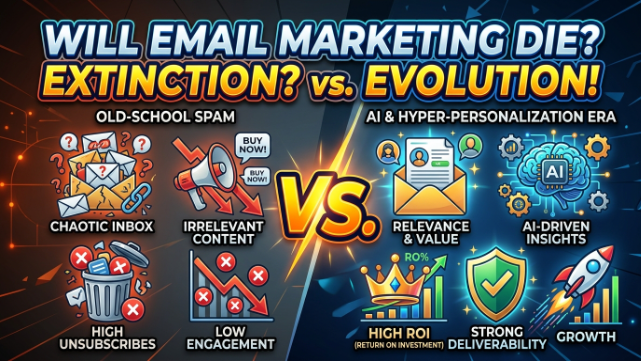
- Email is not dying; it’s consolidating around high-engagement strategies and AI-powered personalization
- Agencies seeing decline are using outdated list-building and segmentation tactics, not because email itself is broken
- The real shift: from spray-and-pray campaigns to intent-based, behavior-triggered messaging
Is Email Marketing Actually Dying?
No. Email marketing is alive and thriving in 2026, but it looks different than it did five years ago. The myth persists because generic, poorly-segmented campaigns have lower open rates but that’s a strategy failure, not a channel failure. Platforms like Mailchimp, ConvertKit, and ActiveCampaign report record revenue in 2026, and the global email marketing market is valued at $11.6 billion (Statista, 2026). The channel has simply evolved to reward smarter senders.
Email Metrics in 2026: The Real Numbers
Email remains the highest-ROI digital marketing channel. According to the Data & Marketing Association (DMA), for every $1 spent on email marketing, businesses receive $42 in return a 4,200% ROI (DMA, 2025). Compare that to paid search ($3–$5 ROI) or social media ($2–$4 ROI), and email’s dominance becomes clear.
Open rates and click-through rates vary wildly by industry and strategy:
| Metric | 2026 Average | Driver |
|---|---|---|
| Open rate | 21–25% | List quality, send time optimization, subject line A/B testing |
| Click-through rate | 2–3% | Segmentation, personalization, clear CTA placement |
| Conversion rate | 2–5% | Landing page relevance, offer quality, audience intent |
| Unsubscribe rate | 0.2–0.5% | Frequency management, content relevance |
These numbers are healthy and stable. What’s changed is the distribution: top-performing senders (those using segmentation and AI) see open rates above 30%, while senders using outdated tactics see 10–15%. The gap has widened, not because email is dying, but because best practices matter more than ever.
Why the “Email Is Dead” Myth Won’t Die
The misconception stems from three sources: declining open rates in aggregate data, email’s invisibility in social media discussions, and the rise of in-app messaging and push notifications as alternatives.The aggregate open-rate decline: Early data from 2015–2020 showed overall email open rates dropping from 28% to 21%. This created panic. But the decline stopped in 2021 and has stabilized since—platforms simply cleaned their data, removed inactive subscribers, and improved tracking accuracy (HubSpot, 2024). Remaining subscribers are more engaged.
Social media bias: Email doesn’t generate viral moments or shareable content, so marketing blogs and thought leaders talk about TikTok and Instagram. Visibility ≠ importance. Email still delivers messages directly to inboxes, with zero algorithmic gatekeeping—something social platforms can’t claim.
Competition from owned-channel alternatives: In-app messaging, SMS, and push notifications are real competitors. But they’re not email replacements—they’re supplements. A mature marketing stack uses all four channels, with email handling nurture and SMS/push handling urgency.
What Changed: The Shift to Behavior-Triggered, Personalized Email
Email didn’t die. The spray-and-paint “email everyone once a week” strategy did.
In 2026, the platforms winning at email use:
Segmentation by behavior, not just demographics. Mailchimp’s 2025 benchmark report shows that segmented campaigns have 14.31% higher open rates and 100.95% higher click rates than non-segmented campaigns (Mailchimp, 2025). Agencies now segment by purchase history, browsing behavior, engagement level, and predicted churn risk.
AI-powered send-time optimization. ConvertKit and ActiveCampaign now send emails at the exact moment each subscriber is most likely to open. This alone lifts open rates by 3–8% (ActiveCampaign, 2025).
Trigger-based workflows. A user abandons a cart at 2 PM on a Tuesday? They get an email 2 hours later. Someone hasn’t opened an email in 60 days? They get a re-engagement sequence. Static batch-and-blast is obsolete.
Dynamic content blocks. The same email template serves different content to different segments—product recommendations based on past purchases, testimonials relevant to their industry, pricing tiers suited to their company size.
Agencies that master these tactics see email performance improve year-over-year. Those that don’t update their playbooks see stagnation and interpret it as channel decline.
Email Platforms Are Growing, Not Shrinking
The email marketing software market is expanding, not contracting. In 2026:
- Mailchimp (Intuit) expanded its AI capabilities and reached 12 million users globally
- ConvertKit (now ConvertKit Pro) launched advanced segment building and AI-powered subject line testing
- ActiveCampaign added predictive send-time and behavioral trigger automation for 35,000+ customers
- HubSpot integrated email more deeply into its CRM workflow, making email the hub of multi-channel campaigns
Larger platforms wouldn’t invest in R&D and new features if the channel were dying. They’re doubling down.
The Real Question: Is Email Right for Your Audience?
Email isn’t dying, but it’s not universal. The channel’s ROI depends entirely on having a qualified list of engaged subscribers who expect to hear from you.
Email works best for:
- E-commerce brands (cart abandonment, product recommendations, loyalty)
- SaaS companies (onboarding, feature education, renewal reminders)
- Content creators and publishers (subscriber retention, monetization)
- B2B services (lead nurture, thought leadership, retention)
- Coaches, consultants, and creators (direct relationship with audience)
Email is less effective for:
- Reaching cold audiences (use ads, content marketing, or social first)
- Viral, time-sensitive announcements (use social or push notifications)
- Highly price-sensitive, low-LTV audiences (acquisition cost exceeds lifetime value)
The mistake agencies make is assuming email is dead when it’s just not the right channel for their specific client or use case. Email didn’t fail; the strategy did.
Common Mistakes to Avoid with Email in 2026
- Buying lists instead of growing them organically. Bought lists have low engagement and hurt sender reputation. Organic, opted-in lists convert 2–3x better.
- Sending too frequently without segmentation. Generic weekly emails to your entire list will increase unsubscribes. Send based on behavior and preference, not a calendar.
- Ignoring mobile optimization. 50%+ of emails are opened on mobile (Statista, 2026). Responsive templates are non-negotiable.
- Using vague subject lines. A/B test subject lines for open rate. “Check this out” loses to “Your Q2 performance report is ready”—specificity wins.
- Not tracking conversions past email click. Know which campaigns drive revenue, not just opens and clicks. Use UTM tracking and CRM integration.
- Neglecting re-engagement campaigns. Remove inactive subscribers every 6 months. Dead weight hurts sender reputation and skews your metrics.
Frequently Asked Questions About Email Marketing in 2026
Is email marketing really worth the effort in 2026?
Yes. Email delivers the highest ROI of any digital channel at $42 per $1 spent (DMA, 2025). It’s the most cost-effective way to nurture leads and retain customers, especially for SaaS, e-commerce, and content creators.
What’s a good email open rate in 2026?
It depends on your industry and how well you segment. Top performers see 25–35% open rates. Average is 18–22%. Low performers get below 15%. If your rate is under 15%, audit your list quality, subject lines, and send times.
Should agencies recommend email or focus on social media?
Both. Email and social serve different purposes. Social builds awareness; email converts and retains. A mature strategy uses both, with email handling the bottom-of-funnel revenue-driving campaigns.
How often should I email my list?
Depends on your audience and content type. B2B SaaS often sends 2–3 times per week. E-commerce sends 3–5. Content creators send 1–2. Test what your audience prefers and segment based on engagement—power users might get daily emails; inactive users get weekly digests.
What email platform should we use in 2026?
It depends on your needs. Mailchimp is best for beginners and small teams. ConvertKit excels for creators. ActiveCampaign wins for advanced automation. HubSpot is strongest for integrated CRM workflows. Klaviyo dominates e-commerce. Evaluate based on your specific use case, team size, and budget.
Is SMS a replacement for email?
No. SMS is a complement. SMS works for time-sensitive alerts and conversions (cart abandonment, delivery notifications). Email works for nurture, relationship building, and content distribution. Use both in your stack.
Key Takeaways
- Email marketing isn’t dying; it’s consolidating around best practices and AI-powered personalization
- The $42 ROI per $1 spent makes email the highest-performing digital channel (DMA, 2025)
- 4.73 billion global email users in 2026 create a massive addressable market (Statista, 2026)
- Agencies seeing poor email results are using outdated tactics, not because email itself is broken
- The 2026 winners use behavior-triggered workflows, AI send-time optimization, and dynamic segmentation
- Email platforms (Mailchimp, ConvertKit, ActiveCampaign) are all growing, not shrinking
- The key question isn’t “Should we use email?” but “Are we using it the right way for our audience?”