

[Published: June 14, 2026 | Last updated: June 14, 2026] | 9 min read
TL;DR
- Mailchimp is still the most beginner-friendly email marketing tool in 2026, but it’s no longer the best overall value for growing businesses (EmailYoo, 2026).
- It holds a 4.4 out of 5 rating on G2 from thousands of verified users (MarketersChoice, 2026).
- The free plan now caps at 500 contacts and 1,000 emails per month – MailerLite’s free plan allows 1,000 contacts and 12,000 emails (EmailVendorSelection, 2025).
- 5,000 contacts on Mailchimp Standard costs $100/month; Brevo’s equivalent starts at $29/month (EmailVendorSelection, 2025).
- Best for: first-time email marketers and small lists under 500 contacts. Not ideal for businesses planning to scale.
Mailchimp has over 12 million users worldwide and was one of the first email tools to offer a free plan with a drag-and-drop builder. That legacy still counts for something. But since Intuit acquired it in 2021, the pricing has climbed steadily while the free tier has shrunk. This review covers what actually changed, what still works, and when you should pick a different tool.
What Is Mailchimp and Who Is It For?
Mailchimp is an email marketing platform that lets businesses build contact lists, design emails, set up automations, and track campaign performance without writing code. It also includes landing page builders, basic CRM features, social media ad management, and a website builder.
It started as a pure email tool for small businesses, and that’s still where it works best. The interface is genuinely easy to learn. Most users can send their first campaign within an hour of signing up, no tutorials needed.
But here’s the honest version: Mailchimp is a great starting tool, not a great ending tool (EmailYoo, 2026). A lot of users start on it, then switch once their list grows past a few thousand contacts and the costs start adding up faster than expected.
Mailchimp Pricing in 2026: What You Actually Pay
Mailchimp’s Standard plan is the most commonly recommended tier, starting at $20/month for up to 500 contacts. The price climbs fast from there.
| Contacts | Mailchimp Standard | Brevo Starter | MailerLite Growing Business |
|---|---|---|---|
| 500 | $20/month | $9/month | $10/month |
| 1,500 | $45/month | $17/month | $25/month |
| 5,000 | $100/month | $29/month | $39/month |
| 10,000 | $135/month | $39/month | $73/month |
| 25,000 | $310/month | $69/month | $159/month |
That pricing gap widens significantly as your list grows. At 25,000 contacts, Mailchimp Standard costs more than four times what Brevo charges.
There are three things that make Mailchimp’s pricing structure frustrating beyond the base rate.
First, sending limits. Standard plan users can send 12x their contact count per month before paying overage fees. Tools like MailerLite have no sending cap at all (EmailVendorSelection, 2025).
Second, double-counting. If the same email address appears on two separate lists, Mailchimp counts it twice toward your contact total. This is a real cost driver for businesses that segment by audience type.
Third, paying for contacts you can’t email. When Mailchimp “cleans” a bounced contact from your list, it still counts that address in your billing total. You pay for contacts you’re barred from sending to (EmailVendorSelection, 2025).
The free plan is technically available but barely usable for most businesses now. 500 contacts, 1,000 emails per month, no automations, no A/B testing, no scheduled sends, and no custom template uploads. You can’t even schedule an email to go out at a specific time (EmailVendorSelection, 2025). MailerLite’s free plan gives you 1,000 contacts and 12,000 emails per month by comparison.
Mailchimp’s Core Features: What You Get
Mailchimp’s email builder is one of its genuine strengths. The drag-and-drop editor is fast, well-designed, and works without any coding knowledge. It comes with 260+ templates across the Standard plan and above (EmailVendorSelection, 2025). A verified Capterra user who manages retail email campaigns called the drag-and-drop interface “impressive,” noting their team could build promotional emails quickly without a designer (Capterra, 2026).
Automation on the Standard plan covers multi-step workflows, behavioral triggers, and send-time optimization. This is enough for most small to mid-sized businesses. The free plan has no automation at all, and the Essentials plan only covers basic automations.
The integration list is a real advantage. Mailchimp connects to 300+ third-party tools, including Shopify, WooCommerce, Wix, Squarespace, Stripe, QuickBooks, Canva, Facebook, Instagram, and LinkedIn (EmailVendorSelection, 2025). Most tools you already use will connect without issue.
Reporting covers open rates, click rates, bounce rates, and revenue tracking if you’re connected to an e-commerce store. The analytics are clear and accessible, which newer users appreciate.
Support is where Mailchimp consistently draws criticism. Free plan users get no live support at all. Paid users get email support, but response times and quality have been flagged repeatedly in user reviews (Sender, 2026). Phone support only comes with the Premium plan, which starts at $350/month.
What Changed After Intuit Bought Mailchimp
Intuit acquired Mailchimp in November 2021 for approximately $12 billion. Since then, the product has seen several changes that shifted how it’s perceived in the email marketing market.
Prices have increased multiple times. The Standard plan, which cost significantly less at acquisition, now sits at $20/month at its entry level with a steep per-contact curve above that.
The free plan has been steadily reduced. Features that were once free – automations, A/B testing, scheduled sends, custom template uploads – have all been moved behind paid tiers. The contact cap dropped from 2,000 to 500.
Contact import rules tightened. Uploading an existing list is now more restrictive. If Mailchimp flags your import, it requires a re-engagement campaign before sending to those contacts – even if the list came from legitimate long-term customers (EmailVendorSelection, 2025). That’s an extra step that wastes time for established senders.
A Short Case Study: When Mailchimp Works and When It Doesn’t
A freelance consultant in Dhaka started a newsletter on Mailchimp’s free plan with around 300 subscribers. It worked perfectly for the first year – simple broadcasts, clean template, zero cost. No complaints.
When her list hit 800 contacts after a product launch, the free plan cut her off. She moved to Essentials at $13/month, which covered basic sends but not the automation she needed to follow up with new subscribers automatically.
By the time she hit 3,000 contacts, she was paying $75/month for Standard, and the double-counting issue added roughly 400 phantom contacts because she ran two separate audience segments. She switched to MailerLite and cut her monthly cost by more than half while getting unlimited sends.
That trajectory – start free, hit a wall at each growth stage, switch tools eventually – is the most common Mailchimp story. It’s not a bad tool. It just charges a premium at every step of scaling.
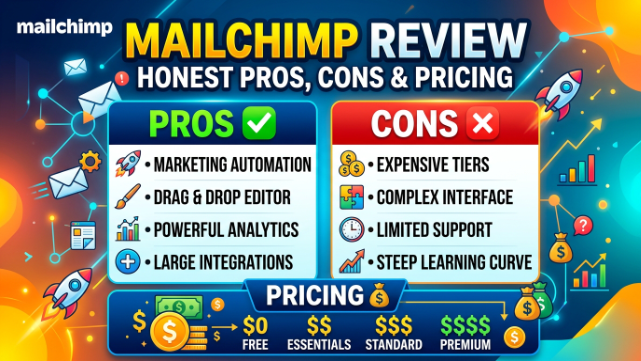
Mailchimp Pros and Cons Summary
What works well:
- Drag-and-drop email builder is genuinely one of the best for beginners
- 300+ integrations with tools most businesses already use
- 260+ email templates on paid plans
- Landing page builder included on all plans including free
- 4.4/5 rating on G2 reflects real user satisfaction at the beginner level (MarketersChoice, 2026)
What doesn’t work well:
- Pricing climbs fast, and competitor tools offer the same features for significantly less
- Double-counting contacts across lists inflates bills without adding value
- Paying for cleaned (undeliverable) contacts is a known frustration
- Free plan too restricted for practical use in 2026
- Customer support quality is below competitors at most price tiers
- Contact import rules are stricter than most alternatives
Mailchimp vs. Alternatives: When to Switch
Mailchimp is the right tool if you’re brand new to email marketing, have under 500 contacts, want maximum integration options, or need the simplest possible setup to get your first campaigns out the door.
Switch to something else if your list is growing past 1,000 contacts, if you need robust automations without a Premium price tag, or if you’re running multiple audiences and getting double-billed for the same addresses.
MailerLite suits users who want lower pricing, unlimited sends, and comparable ease of use. Brevo suits anyone with a large list who’d rather pay by email volume than contact count. ActiveCampaign suits businesses that need CRM functionality baked into their email tool.
Frequently Asked Questions About Mailchimp
Is Mailchimp free in 2026?
Yes, Mailchimp has a free plan, but it’s now limited to 500 contacts and 1,000 emails per month, with no automations, no A/B testing, and no scheduled sends. For most growing businesses, it’s not practical as a long-term free option.
How much does Mailchimp cost per month?
The Standard plan starts at $20/month for up to 500 contacts. At 5,000 contacts it’s $100/month, and at 25,000 contacts it’s $310/month. Competitors like Brevo and MailerLite charge significantly less at the same contact counts (EmailVendorSelection, 2025).
Why does Mailchimp charge for cleaned contacts?
Mailchimp removes bounced emails from your active send list but still counts them toward your billing total. This means you pay for contacts you cannot email. It’s one of the most cited frustrations in user reviews.
Is Mailchimp good for beginners?
Yes. The drag-and-drop builder, clean interface, and large template library make it one of the fastest tools to learn. Most users can launch their first campaign in under an hour with no prior experience.
What is the best Mailchimp alternative?
MailerLite is the closest match in ease of use with significantly lower pricing. Brevo is better for large lists since it charges by emails sent rather than contacts stored. ActiveCampaign is the upgrade path for users who need advanced automation and CRM features.
Key Takeaways
- Mailchimp remains one of the easiest email marketing tools to use, especially for beginners.
- Pricing is a real issue at scale – the gap between Mailchimp and competitors grows significantly past 5,000 contacts.
- The free plan is too restricted for practical business use in 2026.
- Double-counting contacts and billing for cleaned addresses inflate costs beyond the published rates.
- For small lists under 500 contacts who want simplicity and broad integrations, Mailchimp still delivers. Everyone else should compare alternatives before committing.