

Published: May 2026 | Last updated: May 23, 2026 | 8 min read
TL;DR
- Tracker CRM is best for small to mid-market staffing agencies needing affordable all-in-one solutions without enterprise overhead
- Bullhorn dominates enterprise staffing with deep automation and integrations, but costs $1,500+ monthly (Bullhorn, 2026)
- Staffing 360 bridges mid-market needs with strong temp staffing workflows and better affordability than Bullhorn
- Workable wins for tech-focused recruiting teams prioritizing ease of use and quick onboarding
- Lever suits high-volume hiring at growth-stage companies with strong applicant tracking and collaboration
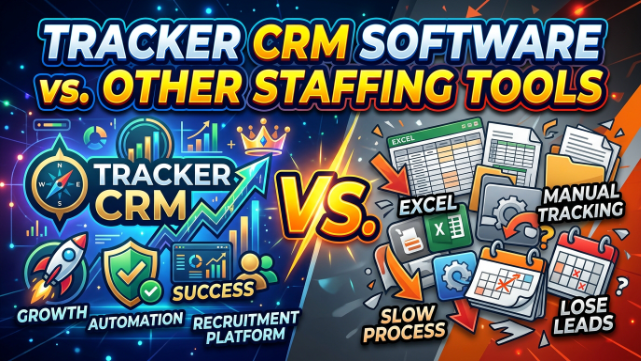
- Your choice depends on company size, budget, and whether you need specialized staffing workflows vs. general recruitment
What Makes a Staffing Tool Different From Regular ATS Software?
Staffing and recruitment software are not the same. A staffing tool manages placements, candidate pools, job orders, and client relationships simultaneously. A general ATS focuses on one hiring workflow.
The key difference: staffing tools track multiple open positions across multiple clients, manage temp-to-hire pipelines, handle billing and timesheet integration, and automate candidate-to-client matching. A recruiter using generic HR software spends hours on manual tasks a staffing platform handles automatically.
This comparison focuses on platforms built for staffing workflows, not general hiring software.
Tracker CRM: Best for Affordable Mid-Market Staffing Agencies
Tracker CRM is a cloud-based recruitment platform designed specifically for staffing agencies and recruitment firms. It combines candidate database management, job order tracking, client relationship tools, and basic automation in one interface.
Key features:
- Centralized candidate database with resume parsing and duplicate detection
- Job order and placement tracking across multiple clients
- Email integration and candidate communication templates
- Client portal for job submissions and placement feedback
- Basic workflow automation and task management
- Mobile app for remote recruitment teams
Pricing: Starts at $299/month for small teams, scales to $999+/month (Tracker CRM, 2026) Best for: Staffing agencies under 30 people, budget-conscious teams, agencies new to software automation Why choose: Lowest entry point, fast implementation (days, not weeks), built specifically for staffing workflows
Limitations: Less advanced automation than Bullhorn, fewer third-party integrations, smaller user community for troubleshooting
Bullhorn: Best for Enterprise Staffing Operations
Bullhorn is the largest pure-play staffing software platform globally, trusted by over 14,000 recruitment firms (Bullhorn, 2026). It handles everything from candidate sourcing to placement tracking to billing automation.
Key features:
- Advanced automation rules and workflow builders
- Deep CRM functionality for managing client relationships
- Integrated job board distribution to 200+ job sites
- AI-powered candidate matching and recommendations
- Bullhorn Mobile and field service automation
- 300+ pre-built integrations (Salesforce, Microsoft Teams, Slack, etc.)
- Advanced reporting and analytics dashboards
Pricing: Custom quotes starting at $1,500+/month; enterprise packages often $5,000+/month (Bullhorn, 2026) Best for: Large staffing agencies (50+ staff), enterprises managing 1,000+ placements monthly, firms needing advanced customization Why choose: Most powerful automation, best candidate matching AI, largest partner ecosystem, proven at enterprise scale
Limitations: Steep learning curve, months-long implementation, premium pricing, overkill for small teams
Staffing 360: Best for Mid-Market Staffing Balance
Staffing 360 Solutions (now part of the Apex Group ecosystem) provides staffing-specific software that bridges the gap between Tracker’s simplicity and Bullhorn’s complexity. It’s designed for agencies that have outgrown basic tools but don’t need enterprise infrastructure.
Key features:
- Customizable job order and placement workflows
- Temp-to-hire pipeline management and automation
- Integrated timesheet and payroll module
- Client billing and invoice automation
- Candidate sourcing and screening tools
- Reporting on placements, revenue, and recruiter performance
Pricing: Typically $800-$2,500/month depending on users and modules (Staffing 360, 2026) Best for: Mid-market agencies (15-100 staff), firms handling temp and direct-hire placements, agencies wanting affordability without losing features Why choose: Strong temp staffing automation, lower cost than Bullhorn, faster implementation than enterprise platforms
Limitations: Smaller user base than Bullhorn, fewer third-party integrations, less advanced AI matching
Workable: Best for Tech-Focused Recruiting Teams
Workable is a hiring platform built for tech companies and growth-stage startups. It excels at general recruitment workflows, especially in software, engineering, and product roles.
Key features:
- Clean, intuitive interface (minimal learning curve)
- Strong job board integration and applicant sourcing
- AI-powered candidate screening and ranking
- Collaborative hiring with feedback workflows
- Video interview and assessment tools built-in
- Integrations with 150+ apps (Slack, GitHub, Jira, LinkedIn, etc.)
- Mobile-friendly candidate experience
Pricing: Starts at $99/month for one open job, team plans at $449-$999/month (Workable, 2026) Best for: Tech-focused teams, companies hiring 10-100 people yearly, teams prioritizing ease of use Why choose: Fastest onboarding, most intuitive UI, excellent for non-recruiters using the platform, strong for sourcing
Limitations: Not built for staffing workflows (no client portal, no temp-to-hire pipeline), weak on CRM for client management, limited customization
Lever: Best for High-Volume Hiring With Collaboration
Lever is an ATS designed for rapidly growing companies that hire dozens of candidates monthly. It prioritizes team collaboration, candidate experience, and hiring analytics.
Key features:
- Strong candidate pipeline visualization and management
- Multi-team collaboration with comment threads and approvals
- Built-in scheduling and interview coordination
- Sourcing tools and CRM for candidate relationships
- Custom reports and hiring analytics
- 200+ integrations including email, Slack, and scheduling tools
- Candidate portal with interview feedback and offer management
Pricing: Starts at $315/month per open job or team plans at $1,000-$3,000/month (Lever, 2026) Best for: Growth-stage companies, teams hiring 50+ people per year, companies that need visibility across hiring managers Why choose: Excellent collaboration features, strong analytics for hiring velocity, great candidate experience
Limitations: Not designed for staffing agencies, no client management portal, no temp-to-hire workflows, no billing or payroll integration
Comparison Table: Staffing Tools at a Glance
| Feature | Tracker CRM | Bullhorn | Staffing 360 | Workable | Lever |
|---|---|---|---|---|---|
| Pricing | $299-$999/mo | $1,500-$5,000+/mo | $800-$2,500/mo | $99-$999/mo | $315-$3,000/mo |
| Best for | Small agencies | Enterprise staffing | Mid-market agencies | Tech recruiting | Growth-stage hiring |
| Client CRM | Yes | Yes | Yes | Basic | Basic |
| Staffing workflows | Yes | Yes | Yes | No | No |
| Temp-to-hire | Basic | Advanced | Advanced | No | No |
| Job board sync | Limited | 200+ | Yes | Yes | Moderate |
| AI matching | No | Yes | Limited | Yes | Yes |
| Integrations | 20+ | 300+ | 50+ | 150+ | 200+ |
| Implementation | Days | Months | Weeks | Days | Weeks |
| Ease of use | Moderate | Steep | Moderate | Easy | Moderate |
| Mobile app | Yes | Yes | Limited | Yes | Yes |
How to Choose: Decision Framework
The right tool depends on three factors.
1. Company size and staffing volume
Small agencies under 20 people placing under 50 candidates monthly should start with Tracker CRM. The lower cost ($299-499/month) frees budget for recruiter training and sourcing. Staffing 360 makes sense at 15-100 staff. Bullhorn becomes cost-effective only above 100 staff or 500+ monthly placements.
2. Staffing vs. general recruiting
If you manage temp placements, temp-to-hire conversions, or timesheet billing, you need a staffing-specific tool. Tracker, Staffing 360, and Bullhorn all handle this. Workable and Lever do not and will create extra work.
3. Budget and implementation speed
Tracker ($300-$999/month) implements in days. Staffing 360 ($800-$2,500/month) takes 2-4 weeks. Bullhorn ($1,500+/month) takes 3-6 months and requires dedicated project management. If you need to move fast, Tracker wins. If you can invest in implementation, Bullhorn’s power justifies the cost.
Common Mistakes to Avoid When Choosing Staffing Software
- Picking a general ATS thinking it handles staffing: Workable and Lever are excellent tools but lack temp-to-hire workflows, client management, and billing. Using them for staffing creates manual work around the software, not within it.
- Overbuying enterprise software for a small team: Bullhorn is powerful but costs 5-10x more than Tracker and requires months to set up. A team of five placing 10 candidates monthly does not need it.
- Ignoring integration needs: If your agency uses payroll software, invoicing platforms, or time tracking tools, check the integration list before buying. Missing integrations mean manual data entry between systems.
- Not considering onboarding and training time: Implementation speed matters. A platform that takes six months to set up delays ROI and team adoption. Prioritize vendors with fast onboarding if your team is small.
- Choosing based on feature count alone: More features don’t equal better fit. Tracker has fewer integrations than Bullhorn but solves the problem faster for small teams. Match features to actual workflow needs.
Frequently Asked Questions About Staffing Software
What is the difference between Tracker CRM and Bullhorn?
Tracker CRM is a mid-market staffing platform that starts at $299/month and implements in days. Bullhorn is an enterprise solution starting at $1,500/month with months-long setup. Tracker suits agencies under 30 people. Bullhorn handles enterprise-scale operations with 100+ staff and advanced automation.
Can I use Workable or Lever for staffing?
Workable and Lever are general recruiting ATS platforms, not staffing tools. They lack client portals, temp-to-hire workflows, and billing integration. Using them for staffing means managing those processes outside the software, adding manual work rather than reducing it.
How much does staffing software cost?
Staffing software ranges from $299-$5,000+ monthly depending on platform and scale. Tracker starts at $299/month. Staffing 360 averages $800-$2,500/month. Bullhorn starts at $1,500/month with enterprise packages reaching $5,000+/month (Bullhorn, 2026). Costs scale with users, job orders, and module add-ons.
How long does it take to implement staffing software?
Tracker CRM and Workable implement in 1-3 days. Staffing 360 typically takes 2-4 weeks. Bullhorn and Lever take 6-12 weeks. Implementation time depends on platform complexity, data migration needs, and integration setup.
Is staffing software worth the cost?
Yes, for agencies placing more than 20 candidates monthly. A recruiter spends 10-15 hours weekly on administrative tasks—database updates, email follow-ups, client coordination, timesheet entry. Staffing software automates most of this, freeing 30-40 hours monthly per recruiter. At $50/hour recruiter cost, that’s $1,500-$2,000 monthly savings per person, justifying the software investment.
What integrations matter most for staffing?
The most valuable integrations are payroll (ADP, Paychex), invoicing (QuickBooks, Freshbooks), job boards (LinkedIn, Indeed, ZipRecruiter), and communication (Gmail, Outlook, Slack). Check if your staffing platform connects to tools you already use before buying.
Can I switch from one staffing platform to another?
Yes, but it requires data migration and retraining. Moving from Tracker to Bullhorn involves exporting candidate and placement data, remapping fields, and rebuilding workflows. Plan 2-4 weeks for migration and budget time for staff retraining. Start with the right tool to avoid this cost.
Which staffing software is easiest to learn?
Workable and Tracker CRM are easiest to learn, with most users productive in 1-2 days. Staffing 360 requires 3-5 days. Bullhorn has the steepest learning curve (2-3 weeks minimum) due to advanced customization options and workflow complexity.
Key Takeaways
- Tracker CRM is the affordable choice for small and mid-market staffing agencies needing quick implementation and staffing-specific workflows
- Bullhorn dominates enterprise staffing with the most advanced automation, AI, and integrations—but costs significantly more
- Staffing 360 bridges mid-market needs, offering more features than Tracker with better pricing than Bullhorn
- Workable excels for tech-focused recruiting teams but lacks staffing workflows needed for temp placement agencies
- Lever is ideal for high-volume hiring at growth-stage companies but isn’t built for staffing agency operations
- Your choice should match company size, placement volume, budget, and whether you manage temp-to-hire pipelines or direct hiring only
- Implementation speed and ease of use matter—fast onboarding saves months of productivity loss
- Missing integrations with payroll or invoicing software create manual workarounds that defeat the tool’s purpose
What’s Next?
Request a demo from your top two choices. Most vendors offer free trials (7-14 days). During the trial, test your actual workflows: create a job order, source a candidate, track a placement, and run a report. If the software doesn’t handle your core processes smoothly, it’s not the right fit regardless of price.
Talk to current users in your industry. Ask about implementation time, support responsiveness, and whether the platform actually saved time or just shifted manual work. That conversation is worth more than any feature comparison.