

Published: July 31, 2026 | Last updated: July 31, 2026 | 15 min read
TL;DR
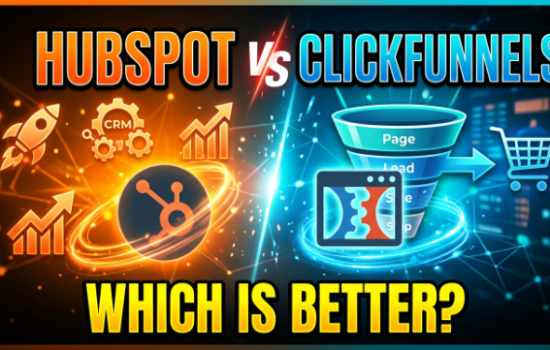
HubSpot and ClickFunnels serve fundamentally different purposes. HubSpot is a CRM-first customer platform with six integrated hubs (Marketing, Sales, Service, CMS, Operations, Commerce) designed for B2B companies managing relationships across hundreds of accounts. ClickFunnels is a funnel-first conversion platform built to guide visitors through a structured buying journey — landing page to checkout to upsell — ideal for entrepreneurs and course creators.
Choose HubSpot if: You’re a growing B2B company with a sales team, need a free CRM to start, and plan to scale into marketing automation, sales pipeline management, and customer service. You have longer sales cycles and need to manage relationships across hundreds of accounts.
Choose ClickFunnels if: You’re an entrepreneur, coach, course creator, or info-product business selling online through direct-response marketing. You need to build high-converting sales funnels without coding. You have a single offer or a small product line and want a flat monthly fee with no surprises.
Bottom line: HubSpot is the best all-in-one CRM and marketing platform for B2B teams. ClickFunnels is the best dedicated sales funnel builder for digital product sellers. They are not direct competitors — they solve different problems. Many businesses use both.
HubSpot vs ClickFunnels: Key Differences at a Glance
| Feature | HubSpot | ClickFunnels |
|---|---|---|
| Starting Price | $0 (Free CRM) | $97/month (Launch) |
| A/B Testing | ✅ Included at $15/seat | ✅ Included at $97 |
| Free Plan | ✅ Yes, never expires | ❌ No free plan |
| CRM | ✅ Full Smart CRM | ❌ Basic contact management |
| Sales Funnels | ❌ Limited (not the focus) | ✅ Built for funnels |
| Landing Pages | ✅ Included in Marketing Hub | ✅ Included |
| Email Marketing | ✅ Included | ✅ Included (with automation) |
| Traffic/Contact Limits | ❌ No cap on free tier | ✅ 20,000 visitors on Launch |
| Design Flexibility | Moderate (template-based) | High (drag-and-drop funnel builder) |
| Best For | B2B companies, sales teams, scaling businesses | Solopreneurs, course creators, digital products |
| G2 Rating | 4.4/5 (2026) | 4.2/5 (2026) |
(HubSpot, 2026; ClickFunnels, 2026; G2, 2026)
What Is HubSpot?
HubSpot is a CRM-first customer platform that connects six product hubs — Marketing, Sales, Service, CMS, Operations, and Commerce — through a shared Smart CRM. It is designed for B2B companies that need to manage relationships across hundreds of accounts, track every interaction, and align marketing, sales, and service teams on shared data. (HubSpot, 2026)
Key features:
- Free CRM that never expires (contact and deal management, basic email tools, forms, live chat)
- Marketing Hub for inbound marketing and automation
- Sales Hub for pipeline management and sales enablement
- Service Hub for customer support and ticketing
- Breeze AI for copy editing, content remixing, and intent tracking
- Over 2,000 integrations with popular business tools
- Smart CRM with unified contact, company, and deal data
Ratings: 4.4/5 on G2 (2026), 4.5/5 on Capterra (2026). However, PCMag notes the “steep learning curve” and pricing complexity for small businesses.
What HubSpot is NOT: HubSpot is not a dedicated sales funnel builder. While you can build landing pages and forms, it lacks the multi-step checkout, upsell, and downsell flows that ClickFunnels provides natively. (ZoomInfo, 2026)
What Is ClickFunnels?
ClickFunnels is a funnel-first conversion platform built specifically to guide visitors through a structured buying journey — landing page to checkout to upsell to downsell — without requiring technical skills. Founded in 2014, it has powered over 1 million funnels and helped 2,000+ users generate over $1 million through a single funnel. (ClickFunnels, 2026)
Key features:
- Drag-and-drop funnel builder with pre-built funnel templates
- Landing pages, order forms, and checkout pages
- Upsell and downsell flows (one-click upsells)
- Email marketing and automation
- Membership site builder
- Basic CRM and contact management
- ClickFunnels 2.0 added website builder and ecommerce features
- No transaction fees
Ratings: 4.2/5 on G2 (2026), 4.4/5 on Capterra (2026).
What ClickFunnels is NOT: ClickFunnels is not a full CRM platform. Its contact management is basic compared to HubSpot’s Smart CRM. It is not designed for complex B2B sales cycles, account-based marketing, or multi-team collaboration. (Spike AI, 2026)
HubSpot vs ClickFunnels: Pricing Comparison
HubSpot Pricing (2026)
| Plan | Monthly Price | Annual Price | Contacts | Best For |
|---|---|---|---|---|
| Free | $0 | $0 | Unlimited (basic) | Getting started with CRM |
| Marketing Hub Starter | $15–$20/seat | $12–$16/seat | 1,000 marketing contacts | Basic email marketing |
| Marketing Hub Professional | $890 | N/A | 2,000 marketing contacts + 3 seats | Advanced marketing automation |
| Marketing Hub Enterprise | $3,600+ | N/A | 10,000 marketing contacts + 5 seats | Large enterprises |
| Sales Hub Starter | $15–$20/seat | $12–$16/seat | Unlimited | Basic sales pipeline |
| Sales Hub Professional | $90–$120/seat | $72–$96/seat | Unlimited | Advanced sales tools |
(HubSpot, 2026; SeQuenzy, 2026)
Important: Marketing Hub Professional includes a **$3,000 mandatory onboarding fee**. Additional 5,000 marketing contacts cost $225/month. (SeQuenzy, 2026)
ClickFunnels Pricing (2026)
| Plan | Monthly Price | Annual Price | Visitors | Best For |
|---|---|---|---|---|
| Launch | $97 | $81/month (billed yearly) | 20,000 | Getting started, 20 funnels, 100 pages |
| Scale | $197 | $164/month (billed yearly) | Unlimited | Growing businesses, more advanced features |
| Optimize | $297 | $247/month (billed yearly) | Unlimited | Full features, advanced automations |
| Dominate | Custom | Custom | Unlimited | Enterprise with custom needs |
Pricing Verdict
The pricing difference is stark. HubSpot offers a genuine free tier that never expires — contact and deal management, basic email tools, forms, and live chat at $0. ClickFunnels has **no free plan**; its Launch plan begins at $97/month.
For B2B teams, HubSpot’s free tier is unbeatable. For solopreneurs, ClickFunnels’ flat monthly fee ($97–$297) is simpler to budget for than HubSpot’s modular pricing that scales unpredictably across seats, hubs, and contact tiers.
One independent 2026 comparison gave HubSpot an 87/100 score versus ClickFunnels’ 77/100, citing better overall value — but that value only materializes if you use the full ecosystem. (Cardia, 2026)
HubSpot vs ClickFunnels: Feature Comparison
CRM and Contact Management
HubSpot: Full Smart CRM with unified contact, company, and deal data. Tracks every interaction across marketing, sales, and service. Free tier includes contact management, deal management, basic email tools, forms, and live chat. Professional tiers add advanced segmentation, lead scoring, and custom reporting.
ClickFunnels: Basic contact management integrated into the funnel builder. You can track contacts through funnels, segment by activity, and manage email lists. But it lacks the depth of a full CRM — no company records, no deal tracking, no service ticketing.
Verdict: HubSpot wins decisively. ClickFunnels’ CRM is functional but basic. (ZoomInfo, 2026)
Sales Funnels
HubSpot: Limited funnel capabilities. You can build landing pages and forms, but multi-step checkout, upsell, and downsell flows are not natively supported. HubSpot focuses on lead generation and nurturing rather than direct sales conversion funnels.
ClickFunnels: Built entirely for funnels. From landing page to checkout to upsell to downsell — all in one seamless flow. Includes one-click upsells, order bumps, and custom checkout pages. The drag-and-drop funnel builder is purpose-built for conversion optimization.
Verdict: ClickFunnels wins by a landslide. HubSpot is not a funnel tool. (Spike AI, 2026)
Landing Pages
HubSpot: Landing pages are included in Marketing Hub. Template-based design with moderate flexibility. Includes forms, CTAs, and A/B testing on Professional plans. Integrates with the Smart CRM for lead tracking.
ClickFunnels: Landing pages are the first step in every funnel. Drag-and-drop editor with more design flexibility. Pre-built funnel templates optimized for conversion. A/B testing included on all paid plans.
Verdict: Both offer good landing page builders. ClickFunnels is better for conversion-focused funnels; HubSpot is better for lead generation integrated with CRM. (RevenueGeeks, 2026)
Email Marketing and Automation
HubSpot: Full email marketing platform. Free tier includes basic email tools (2,000 monthly email sends). Starter adds email marketing, analytics, and forms. Professional adds marketing automation, advanced segmentation, A/B testing, lead scoring, and social publishing.
ClickFunnels: Email marketing built into the funnel builder. Includes email sequences and automation triggered by funnel actions (opt-in, purchase, upsell). But the capabilities are more basic — no advanced segmentation, lead scoring, or social publishing.
Verdict: HubSpot wins for advanced marketing automation. ClickFunnels is sufficient for basic funnel email sequences. (HubSpot, 2026)
A/B Testing
HubSpot: A/B testing is available on Professional plans ($890/month) and above. Includes testing of landing pages, emails, and CTAs. Advanced reporting and statistical significance built in.
ClickFunnels: A/B testing is included on every paid plan starting at $97/month. You can test variations of any funnel step — landing pages, checkout pages, order forms. Simple to set up and monitor.
Verdict: ClickFunnels wins for making A/B testing accessible at $97. HubSpot gates it behind its much more expensive Professional tier. (Cardia, 2026)
Integrations
HubSpot: Over 2,000 marketplace integrations with popular business tools — Salesforce, Slack, Zoom, Shopify, WordPress, and many more. Native integrations across all six hubs.
ClickFunnels: 150+ integrations with email marketing, payment processing, membership platforms, and other tools. Zapier and custom webhooks available.
Verdict: HubSpot wins with a much larger integration ecosystem. (HubSpot, 2026)
AI Capabilities
HubSpot: Breeze AI for copy editing, content remixing, intent tracking, and predictive lead scoring. AI-powered content creation and optimization tools.
ClickFunnels: Limited AI capabilities. Basic AI-powered copy suggestions and funnel recommendations. No advanced predictive features.
Verdict: HubSpot wins for AI capabilities. ClickFunnels is behind on AI integration. (HubSpot, 2026)
Ecommerce Features
HubSpot: Commerce Hub allows you to create product catalogs, accept payments, manage subscriptions, and track revenue in the CRM. Integrated with Shopify and other ecommerce platforms.
ClickFunnels: Built for digital products, courses, and coaching. Checkout pages, order forms, one-click upsells, and payment processing. No inventory management or complex product catalogs.
Verdict: HubSpot is better for B2B ecommerce and subscriptions; ClickFunnels is better for digital product sales. (Shopify, 2026)
HubSpot vs ClickFunnels: Pros and Cons
HubSpot Pros and Cons
Pros:
- Free CRM that never expires (HubSpot, 2026)
- Unified platform across marketing, sales, and service (HubSpot, 2026)
- Over 2,000 integrations (HubSpot, 2026)
- Strong AI capabilities with Breeze AI (HubSpot, 2026)
- 4.4/5 on G2 (2026) and 4.5/5 on Capterra (2026)
- Scales from startups to enterprises
- Excellent sales and service tools
Cons:
- Pricing scales unpredictably across seats, hubs, and contact tiers (SeQuenzy, 2026)
- Marketing Hub Professional jumps to $890/month with $3,000 onboarding fee (SeQuenzy, 2026)
- Steep learning curve — PCMag notes it “can pose challenges for very small businesses” (PCMag, 2026)
- Customization limits versus Salesforce (Salesforce, 2026)
- Not designed for sales funnels (ZoomInfo, 2026)
- Data privacy concerns emerged in July 2026 (TechCrunch, 2026)
ClickFunnels Pros and Cons
Pros:
- A/B testing on every paid plan starting at $97 (ClickFunnels, 2026)
- Purpose-built for sales funnels (ClickFunnels, 2026)
- One-click upsells and downsells built in
- No transaction fees (ClickFunnels, 2026)
- Over 1 million funnels created (ClickFunnels, 2026)
- 4.2/5 on G2 (2026)
- Flat monthly pricing — simple to budget for (ClickFunnels, 2026)
- Built for non-technical users
Cons:
- No free plan (ClickFunnels, 2026)
- Traffic caps on Launch plan (20,000 visitors) (ClickFunnels, 2026)
- Basic CRM compared to HubSpot (ZoomInfo, 2026)
- Limited integration ecosystem compared to HubSpot
- Not designed for B2B sales cycles (Spike AI, 2026)
- Less AI capability than HubSpot
- Customer support complaints — Spike AI notes “limited integrations” as a common concern
HubSpot vs ClickFunnels vs Salesforce: Three-Way Comparison
| Feature | HubSpot | ClickFunnels | Salesforce |
|---|---|---|---|
| Starting Price | $0 (free CRM) | $97/month | $25/user/month |
| Primary Use Case | CRM + marketing + sales | Sales funnels | Enterprise CRM |
| Free Tier | ✅ Yes | ❌ No | ❌ No |
| Sales Funnels | ❌ No | ✅ Yes | ❌ No |
| Marketing Automation | ✅ Yes (paid) | ✅ Basic | ✅ Yes (paid add-on) |
| Customization | Moderate | Low | Very high |
| AI Capabilities | Strong (Breeze AI) | Basic | Very strong (Agentforce) |
| Security Certifications | Standard | Standard | FedRAMP High, HIPAA, SOC 2 Type II |
| Best For | SMB and mid-market B2B | Solopreneurs, digital products | Enterprise |
(HubSpot, 2026; ClickFunnels, 2026; Salesforce, 2026)
When to choose HubSpot: If you’re a B2B company that needs a unified platform for marketing, sales, and service. The free CRM gets you started without commitment. (ZoomInfo, 2026)
When to choose ClickFunnels: If you’re selling digital products, courses, or coaching and need conversion-focused funnels. Flat monthly pricing is simpler than HubSpot’s modular model. (Spike AI, 2026)
When to choose Salesforce: If you’re an enterprise that needs deep customization, advanced security certifications, and is willing to invest in implementation. (Salesforce, 2026)
HubSpot vs ClickFunnels vs Shopify: Funnels vs Ecommerce
| Feature | HubSpot | ClickFunnels | Shopify |
|---|---|---|---|
| Primary Use Case | CRM + marketing | Sales funnels | Full ecommerce store |
| Product Catalog | Moderate (Commerce Hub) | Small | Unlimited products |
| Inventory Management | Basic | None | Advanced |
| Checkout | Basic | One-click upsells | Full checkout |
| Blogging/SEO | ✅ Yes | ❌ Limited | ✅ Yes |
| Payments | ✅ Yes | ✅ Yes | ✅ Yes (Shopify Payments) |
| Best For | B2B companies | Digital products | Physical retail |
(Shopify, 2026; ClickFunnels, 2026; HubSpot, 2026)
ClickFunnels does not replace Shopify — they serve different but complementary purposes. ClickFunnels handles front-end acquisition funnels; Shopify handles the back-end store, inventory, and fulfillment. Many successful brands use both. (Supliful, 2026)
Is HubSpot Worth the Money?
HubSpot is worth it for B2B companies that need a unified customer platform and will use multiple hubs (Marketing, Sales, Service). It earns 4.4/5 on G2 (2026) and 4.5/5 on Capterra (2026). The free tier is genuinely useful for startups. However, the jump to Professional ($890/month + $3,000 onboarding) is significant. (SeQuenzy, 2026)
HubSpot is worth it if: You’re a B2B company with a sales team, you need a unified platform for marketing, sales, and service, you have the budget for paid tiers ($15–$890/month), and you’ll use the full ecosystem.
HubSpot is not worth it if: You’re a solopreneur, you only need simple funnels, you’re on a tight budget, or you don’t need advanced marketing automation. (PCMag, 2026; RevenueGeeks, 2026)
Is ClickFunnels Good?
ClickFunnels is excellent for its target audience — solopreneurs, course creators, and digital product sellers who need conversion-focused funnels. It earns 4.2/5 on G2 (2026) and 4.4/5 on Capterra (2026). A/B testing on every paid plan starting at $97 is a standout feature. (ClickFunnels, 2026)
ClickFunnels is good if: You’re selling digital products, courses, or coaching, you need one-click upsells and downsells, you want a flat monthly fee, and you’re non-technical.
ClickFunnels is not good if: You need a full CRM, you’re a B2B company with longer sales cycles, you need advanced marketing automation, or you want deep integration with existing systems. (Spike AI, 2026)
What Is Better Than HubSpot?
Several platforms outperform HubSpot in specific use cases:
- For sales-first teams: Pipedrive offers a visual CRM built for sales performance without the marketing bundle. (Pipedrive, 2026)
- For enterprise scale and customization: Salesforce provides deeper customization, more features, and enterprise-grade security (FedRAMP High, HIPAA, SOC 2 Type II). (Salesforce, 2026)
- For budget-conscious businesses: Zoho CRM offers flexibility at a fraction of HubSpot’s cost. (Zoho, 2026)
- For agencies and white-label needs: GoHighLevel matches ClickFunnels’ funnel capabilities while adding CRM, but HubSpot costs 3-5x more. (GoHighLevel, 2026)
- For all-in-one workspaces: Lark provides CRM and collaboration in one workspace. (Lark, 2026)
What Is Better Than ClickFunnels?
Several platforms outperform ClickFunnels in specific use cases:
- For full ecommerce stores: Shopify offers unlimited products, inventory management, and full checkout. (Shopify, 2026)
- For enterprise paid teams: Instapage offers AdMap, personalization, and pixel-perfect design for high-volume ad campaigns. (Instapage, 2026)
- For design flexibility: Webflow offers complete design control starting at $14/month. (Webflow, 2026)
- For mobile speed: Swipe Pages offers AMP support starting at $29/month. (Spike AI, 2026)
- For budget users: Landingi starts at $29/month with a free plan. (RevenueGeeks, 2026)
- For B2B funnels: Unbounce offers builder flexibility and AI optimization. (Ecommerce Paradise, 2026)
Who Should Use HubSpot?
Best fit for:
- B2B companies with sales teams — HubSpot’s Smart CRM tracks every interaction across marketing, sales, and service. (HubSpot, 2026)
- Growing companies — Start with the free tier and scale into paid hubs as you grow. (HubSpot, 2026)
- Marketing teams — The Marketing Hub is purpose-built for inbound marketing, lead generation, and nurturing.
- Sales teams — Sales Hub offers pipeline management, deal tracking, and sales enablement tools.
- Customer service teams — Service Hub includes ticketing, knowledge base, and customer feedback tools.
- Companies with longer sales cycles — HubSpot’s nurturing and lead scoring tools are designed for complex B2B buying journeys. (ZoomInfo, 2026)
Who Should Use ClickFunnels?
Best fit for:
- Entrepreneurs and solopreneurs — One-person businesses selling digital products. (ClickFunnels, 2026)
- Course creators — Build a funnel to sell online courses with checkout, upsells, and membership areas. (Spike AI, 2026)
- Coaches — High-ticket coaching programs with application funnels and payment plans.
- Info-product businesses — Digital downloads, ebooks, and software products.
- Affiliate marketers — Fast funnels that send traffic to affiliate offers.
- Beginners — Non-technical users can build a complete funnel in a day. (ClickFunnels, 2026)
Frequently Asked Questions
Is HubSpot better than ClickFunnels?
HubSpot scores higher in independent 2026 comparisons — 87/100 versus ClickFunnels’ 77/100 — driven by its free CRM, unified ecosystem, and broader feature set. But “better” depends on your use case. HubSpot is better for B2B companies with sales teams; ClickFunnels is better for entrepreneurs selling digital products through funnels. (Cardia, 2026)
What is the main difference between ClickFunnels and HubSpot?
ClickFunnels is a funnel-first conversion platform built to guide visitors through a structured buying journey. HubSpot is a CRM-first customer platform that connects marketing, sales, and service from shared data. (ZoomInfo, 2026)
What are the disadvantages of HubSpot?
HubSpot’s main disadvantages are pricing complexity (costs scale unpredictably across seats, hubs, and contacts), a steep learning curve, customization limits versus Salesforce, and slower AI feature rollout compared to AI-native competitors. (PCMag, 2026; SeQuenzy, 2026)
What is better than HubSpot?
Pipedrive is better for sales-first teams. Salesforce is better for enterprise scale and customization. Zoho CRM is better for budget-conscious businesses. GoHighLevel is better for agencies needing white-label tools. (Pipedrive, 2026; Salesforce, 2026)
Is ClickFunnels better than Shopify?
ClickFunnels and Shopify serve different purposes. ClickFunnels is better for sales funnels and single-offer businesses. Shopify is better for full ecommerce stores with large product catalogs. Many successful brands use both together. (Supliful, 2026)
Does ClickFunnels replace Shopify?
No. ClickFunnels does not replace Shopify — they serve different but complementary purposes. ClickFunnels handles front-end acquisition funnels; Shopify handles the back-end store, inventory, and fulfillment. (Shopify, 2026)
How much does HubSpot Marketing Hub cost in 2026?
Marketing Hub Starter: $15–$20/seat/month. Professional: $890/month with a $3,000 onboarding fee. Enterprise: from $3,600/month. (HubSpot, 2026; SeQuenzy, 2026)
How much does ClickFunnels cost in 2026?
ClickFunnels Launch: $97/month. Scale: $197/month. Optimize: $297/month. (ClickFunnels, 2026)
Can you use HubSpot and ClickFunnels together?
Yes. Both platforms offer integrations and can be used together — HubSpot for CRM and marketing automation, ClickFunnels for front-end funnel building. (ZoomInfo, 2026)
Is HubSpot worth the money in 2026?
HubSpot is worth it for B2B companies that need a unified customer platform and will use multiple hubs (Marketing, Sales, Service). It is not worth it for businesses that only need email marketing or simple funnels — the cost and complexity are excessive for those use cases. (RevenueGeeks, 2026)
What is the alternative to ClickFunnels?
The best alternatives to ClickFunnels in 2026 include HubSpot (CRM + marketing), Shopify (full ecommerce), Instapage (enterprise landing pages), Unbounce (builder flexibility), and Landingi (budget). (Ecommerce Paradise, 2026)
Which platform has better A/B testing?
ClickFunnels includes A/B testing on every paid plan starting at $97/month. HubSpot includes A/B testing only on Professional plans starting at $890/month. ClickFunnels wins for accessibility. (Cardia, 2026)
Which platform has better AI capabilities?
HubSpot’s Breeze AI offers copy editing, content remixing, intent tracking, and predictive lead scoring. ClickFunnels has basic AI-powered copy suggestions. HubSpot wins for AI capabilities. (HubSpot, 2026)
Key Takeaways
- HubSpot and ClickFunnels serve fundamentally different purposes. HubSpot is a CRM-first customer platform for B2B companies; ClickFunnels is a funnel-first conversion platform for digital product sellers. (HubSpot, 2026; ClickFunnels, 2026)
- HubSpot offers a genuine free CRM that never expires — contact and deal management, basic email tools, forms, and live chat at $0. ClickFunnels has no free plan; its Launch plan begins at $97/month. (HubSpot, 2026; ClickFunnels, 2026)
- HubSpot scores 87/100 against ClickFunnels’ 77/100 in independent 2026 comparisons, driven by its free CRM and unified ecosystem. (Cardia, 2026)
- ClickFunnels includes [A/B testing on every paid plan starting at $97](https://www.clickfunnels.com/pricing); HubSpot gates A/B testing behind its $890/month Professional tier. (ClickFunnels, 2026; HubSpot, 2026)
- HubSpot’s Marketing Hub Professional costs $890/month plus a $3,000 onboarding fee — a steep climb from its free tier that surprises most buyers. (SeQuenzy, 2026)
- ClickFunnels does not replace Shopify — they serve different purposes. ClickFunnels builds funnels; Shopify builds full ecommerce stores. Many successful brands use both. (Supliful, 2026)
- HubSpot wins for B2B companies with sales teams; ClickFunnels wins for entrepreneurs selling digital products through funnels. Choose based on your business model, not just features. (ZoomInfo, 2026)
- For most growing teams, HubSpot offers the best value with its free CRM. For solopreneurs focused on sales funnels, ClickFunnels’ flat monthly pricing ($97–$297) is simpler to budget for. (RevenueGeeks, 2026)