

[Published: June 14, 2026 | Last updated: June 14, 2026] | 11 min read
TL;DR
- ActiveCampaign is the strongest mid-market marketing automation platform in 2026, earning 4.4 out of 5 on G2 from 14,701 verified reviews – the largest review count of any email automation tool on the platform (G2, 2026).
- Four plans in 2026: Starter at $15/month, Plus at $49/month, Pro at $79/month, and Enterprise at $145/month – all for 1,000 contacts on annual billing (Scribe, 2026).
- There is no free plan. A 14-day free trial runs on all tiers without a credit card.
- Costs scale sharply with contact count. The Starter plan jumps from $15/month at 1,000 contacts to $125/month at 25,000 contacts (AI:Productivity, 2026).
- Real monthly costs run 30-50% above headline prices once extra users, SMS, and CRM add-ons are included (Konabayev, 2026).
- Best for: B2B teams, agencies, and growing businesses that need deep automation and CRM without moving to Salesforce or HubSpot Enterprise.
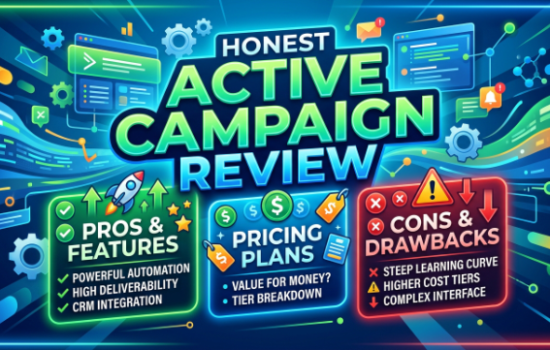
ActiveCampaign built its reputation on one thing: automation that actually works the way marketers think. After 14,701 G2 reviews, that reputation holds. But pricing has become a genuine friction point since the 2024 plan restructure, customer support quality is inconsistent at lower tiers, and the email builder trails competitors. This review covers the full picture – what it does better than anything else, where it falls short, and exactly what you will pay.
What Is ActiveCampaign and Who Is It For?
ActiveCampaign is a marketing automation platform combining email marketing, CRM, automation workflows, SMS, landing pages, and site tracking in one system. It describes itself as an “autonomous marketing platform” built around AI-driven execution and customer journey orchestration across email, SMS, and WhatsApp.
Unlike Mailchimp, which started as an email tool and added automation later, ActiveCampaign was built automation-first. That shows in the depth of its workflow builder, the granularity of its segmentation, and the number of behavioral triggers available at every plan tier.
It is not the cheapest option. It is not the simplest. And it has never tried to be. The platform targets businesses that have outgrown basic broadcast email and need personalized, behavior-triggered sequences that run without manual intervention – sales teams tracking deals, agencies managing multiple client journeys, and e-commerce brands building post-purchase flows.
Over 180,000 businesses in 170 countries use ActiveCampaign as of 2026 (Flowium, 2026).
ActiveCampaign Pricing in 2026: All Four Plans Explained
ActiveCampaign uses contact-based pricing across four tiers. All prices below are annual billing rates for 1,000 contacts, verified across multiple independent sources as of May 2026.
| Plan | Price (1K contacts, annual) | Key Features Unlocked |
|---|---|---|
| Starter | $15/month | Email marketing, basic automation, 1 user seat |
| Plus | $49/month | CRM, landing pages, lead scoring, SMS, 1 user seat |
| Pro | $79/month | Predictive sending, unlimited automation, attribution, 3 user seats |
| Enterprise | $145/month | Custom reporting, premium CRM integrations, 5 user seats, dedicated support |
That entry price looks low. The catch is how fast it climbs with contacts.
| Contacts | Starter | Plus | Pro | Enterprise |
|---|---|---|---|---|
| 1,000 | $15/month | $49/month | $79/month | $145/month |
| 5,000 | $69/month | $99/month | $149/month | $239/month |
| 10,000 | $149/month | $189/month | $375/month | $589/month |
| 25,000 | $125/month | $349/month | Custom | Custom |
(SendX, 2026; AI:Productivity, 2026)
Most serious users land on Plus or Pro. Starter has no CRM, no landing pages, no SMS, and no predictive sending. It is fine for a blogger or solo creator sending basic sequences. Any business running sales alongside marketing will hit its limits quickly (Scribe, 2026).
Switching from monthly to annual billing saves roughly 20% across every tier. A Plus plan at 1,000 contacts costs $49/month on annual billing versus $59/month on monthly – that is $120 saved per year on the entry Plus tier alone (Scribe, 2026).
The Hidden Costs: What You Actually Pay
The base plan price covers less than most buyers assume. Several costs sit outside the plan headline.
Extra user seats cost additional per month on Starter and Plus, which each include only one user seat. Professional includes three seats. Enterprise includes five. Any team larger than these allowances pays per additional user added (GetAIPerks, 2026).
Transactional email – for receipts, password resets, order confirmations – is a separate paid add-on not included in any plan by default.
SMS and WhatsApp messaging are charged per message on top of plan costs. They are not bundled at any tier.
CRM Pipelines for sales teams are an add-on on lower plans. The Sales engagement module starts at $159/month for up to 7,500 contacts as a separate product entirely (Flowium, 2026).
When extra users, SMS credits, and add-ons are factored in, real monthly spend runs 30-50% above the headline plan price for most teams (Konabayev, 2026). Budget for that gap before committing.
ActiveCampaign does not charge for unsubscribed, unconfirmed, or bounced contacts. Only active contacts count toward billing – a meaningful advantage over tools that bill for every address regardless of status (SendX, 2026).
The 2024 Plan Restructure: What Changed and Why It Matters
In August 2024, ActiveCampaign replaced its old Lite, Plus, Professional, Enterprise structure with the current Starter, Plus, Pro, Enterprise naming. Features were rearranged across tiers and bundle discounts were removed in favor of individual add-ons.
Existing customers were migrated automatically on their next billing date after August 5, 2024, with approximately 14 days’ notice. Annual subscribers saw changes as late as August 2025 at their renewal date. Price increases were capped at 30% for migrating customers (Flowium, 2026).
This is worth knowing for two reasons. First, older reviews on G2 and Capterra may reference plan names and prices that no longer exist. Second, the restructure is the direct cause of the pricing frustration that appears in 506 G2 reviews flagging cost as a barrier. Several features that were bundled cheaply on the old Lite plan now require Plus or above.
What ActiveCampaign Does Better Than Anyone Else
The automation builder is the platform’s defining feature and the reason 14,701 people have taken time to write a review. An agency owner with four years on the platform put it clearly on G2: the visual workflow editor makes it easy to map multi-step nurture sequences, behavioral triggers, and conditional logic without a developer, while remaining clean enough for a new team member to learn in a day or two (G2, 2026).
That balance – powerful enough for complex multi-branch logic, accessible enough that non-technical marketers can build without training – is rare. HubSpot’s automation requires Professional at $890/month to match it. Mailchimp’s automation is shallower at any price.
Conditional content on the Pro plan takes personalization further than most tools attempt. A CEO on G2 described using it to show different email copy based on whether each subscriber had purchased a specific product – displaying a promotional postscript only to non-buyers while showing different content to existing customers, all inside a single campaign send (G2, 2026). That level of per-subscriber personalization inside a single send is genuinely unusual.
Segmentation depth on Plus and above uses a mix of tags, custom fields, behavioral data, and site tracking to build audiences at a granularity most mid-market tools can’t reach. A solutions engineer on G2 called this the platform’s biggest technical advantage – the ability to personalize messaging at scale without needing multiple tools stitched together (G2, 2026).
The integration library covers over 1,000 third-party apps. Native connections with WordPress, Shopify, Meta, Salesforce, Google Analytics, Calendly, and Leadfeeder work reliably without Zapier middleware for most standard workflows. When custom configurations are needed, the API is well-documented.
An enterprise sales and marketing specialist who migrated from Mailchimp noted that the CRM sync, Google Analytics integration, and AI content suggestion features all worked well together for campaign creation – with the workflow builder handling triggers from form submissions and page visits without manual intervention (G2, 2026).
What ActiveCampaign Does Poorly
The email builder is the most consistent specific complaint. A Chief Creative Officer on G2 called it “clunky, hard to use, and not very intuitive” while giving the automation a perfect score (G2, 2026). This sentiment appears across hundreds of reviews. The builder works but lags behind Mailchimp, Brevo, and MailerLite in design flexibility and ease of use.
Reporting is underwhelming given the platform’s price point. Basic campaign metrics are clear enough. But analytics inside automation journeys, attribution across touchpoints, and campaign comparison over time all require significant manual effort to extract. A Chief Creative Officer on G2 described the reporting system as “difficult to understand and navigate” even for straightforward metrics like open rates and click-through rates (G2, 2026). Pro and Enterprise unlock better dashboards, but the gap to competitors like HubSpot’s reporting suite remains noticeable.
Customer support quality is uneven. 321 G2 reviews flag poor customer support, and the pattern in those reviews is consistent: common issues get resolved quickly, but technical questions about complex automation behavior take significantly longer (G2, 2026). Phone support is not available on Starter or Plus.
Account shutdowns without warning appear in recent reviews and deserve attention. A CEO on G2 in March 2026 described having an eight-year account shut down overnight with no prior notice – describing the platform’s functionality positively while giving it a zero-star overall rating because of how the account closure was handled (G2, 2026). This appears to be related to spam compliance enforcement, but the communication around such actions is a real operational risk for businesses that rely on the platform.
Managing large automation libraries becomes difficult as complexity grows. A sales and marketing specialist noted that workspaces with many simultaneous tags, lists, and workflows start to feel disorganized without strict naming conventions and folder discipline (G2, 2026).
A Short Case Study: Agency Managing Eight Client Accounts
A boutique digital agency in Dhaka managing eight B2B SaaS clients evaluated ActiveCampaign Plus against HubSpot Marketing Hub Starter in early 2026.
HubSpot’s free CRM was appealing, but Marketing Hub Professional at $890/month was the only tier that unlocked the automation depth they needed across client journeys. ActiveCampaign Plus at $49/month for 1,000 contacts – even with eight separate client setups – came in at a fraction of that cost.
The migration from three separate tools took two weeks. They built automated lead qualification workflows, post-demo nurture sequences, and win-back campaigns for each client inside a single ActiveCampaign account using separate pipelines. Reported manual follow-up time across the team dropped by around 60% within the first quarter.
The friction was the email builder. Their designer spent the first month adapting to its limitations before building a library of pre-built templates that the team reuses across clients. That workaround solved the problem, but it cost setup time that a better builder wouldn’t have required.
ActiveCampaign vs. Alternatives
| Tool | Best For | Starting Price | Key Difference |
|---|---|---|---|
| Mailchimp | Beginners and small lists | $0 / $9/month | Simpler interface, weaker automation, charges by contacts |
| Brevo | Large lists, low send frequency | $0 / $9/month | Volume-based pricing, multichannel, shallower automation |
| HubSpot Marketing Hub | B2B inbound + deep CRM | $0 / $20/month | Better reporting and CRM, but $890/month for real automation |
| Klaviyo | E-commerce personalization | $0 / $45/month | Superior revenue attribution for stores, charges by contacts |
| MailerLite | Budget creators and newsletters | $0 / $10/month | Simpler and cheaper, no behavioral automation depth |
| Pipedrive | Sales CRM with basic email | $14/user/month | Better pure pipeline management, weaker email automation |
Frequently Asked Questions About ActiveCampaign
Does ActiveCampaign have a free plan?
No. ActiveCampaign does not offer a free plan in 2026. A 14-day free trial is available on all four plan tiers without requiring a credit card. The trial gives full access to Pro-level features.
How much does ActiveCampaign cost for 10,000 contacts?
At 10,000 contacts on annual billing, Starter costs $149/month, Plus costs $189/month, Pro costs $375/month, and Enterprise costs $589/month. These are base plan prices before add-ons (SendX, 2026).
What is the best ActiveCampaign plan for a small business?
Plus at $49/month for 1,000 contacts is the right starting point for most small businesses. It adds CRM, landing pages, lead scoring, and SMS that Starter lacks. Starter is workable only for solo creators or bloggers sending simple sequences without sales tracking.
Does ActiveCampaign charge for unsubscribed contacts?
No. ActiveCampaign only bills for active contacts. Unsubscribed, unconfirmed, and bounced addresses do not count toward your contact limit – a meaningful advantage for businesses with large inactive segments they prefer to keep on file (SendX, 2026).
Is ActiveCampaign better than HubSpot for automation?
Yes, at a significantly lower price. ActiveCampaign Pro at $79/month delivers automation depth that HubSpot doesn’t match until Marketing Hub Professional at $890/month. HubSpot wins on reporting quality and CRM depth. ActiveCampaign wins on automation flexibility and price-to-capability ratio for marketing-led teams.
What changed in the 2024 ActiveCampaign plan restructure?
The old Lite, Plus, Professional, Enterprise tiers were replaced by Starter, Plus, Pro, Enterprise. Features were redistributed across tiers, bundle discounts were removed, and add-ons were separated out for individual pricing. Existing users were migrated automatically from August 2024, with price increases capped at 30% (Flowium, 2026).
Key Takeaways
- ActiveCampaign’s automation builder is the best in its price range – nothing at comparable cost comes close to its workflow depth, conditional logic, or behavioral trigger options.
- Pricing scales aggressively with contact count. A Starter plan that looks cheap at 1,000 contacts costs $125/month at 25,000 contacts.
- Real costs run 30-50% above headline prices when extra users, SMS, and CRM add-ons are included.
- The email builder and reporting quality are genuine weaknesses that competitors handle better.
- Plus at $49/month is the minimum workable plan for most businesses. Starter lacks CRM, landing pages, and SMS.
- Best fit is B2B teams, agencies, and automation-heavy businesses. Not the cheapest choice – the most capable choice at the mid-market price point.